
- The short version
- What iPhone Duo is
- Displays
- Size and weight
- Durability
- Price, storage and how to pay
- Dates and countries
- Chip, modem and wireless
- eSIM only, everywhere
- Battery and charging
- Cameras
- iOS 27 on iPhone Duo
- What you give up versus iPhone 18 Pro Max
- What iPhone Duo has that iPhone 18 Pro Max does not
- Storage: how much is really yours
- Accessories
- FAQs
The short version
- iPhone Duo is the first foldable iPhone, introduced September 9, 2026, with a grade 5 titanium body in Night Sky and Star White.
- The inner folding display is 7.6 inches, which Apple calls the largest display of any iPhone, and the outer display is 5.4 inches.
- Four capacities, from $1,999.00 (₹299900.00) for 256GB up to $3,199.00 (₹449900.00) for 2TB.
- Pre-orders open at 5:00 a.m. PT on Friday, October 16, 2026, and it goes on sale Friday, October 23, 2026.
What iPhone Duo is
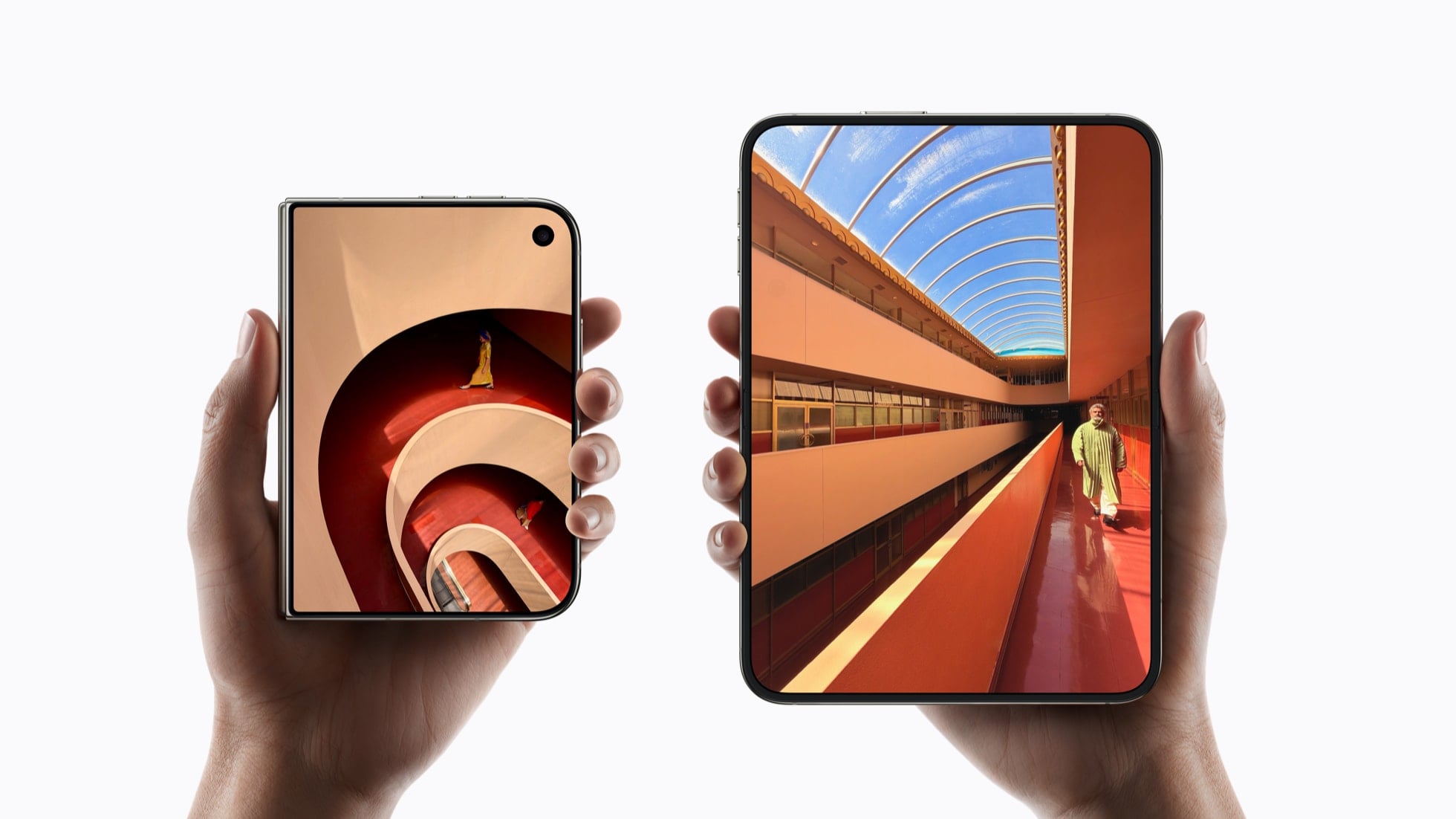
Open, iPhone Duo has an inner display 50 percent larger than the one on iPhone 18 Pro Max. Closed, the 5.4-inch outer display covers 90 percent of the screen area of iPhone 18 Pro. Apple’s iPhone Duo product page describes the phone as foldable, posable and durable.
Both panels share one aspect ratio, so content keeps its shape as the phone opens and closes. The inner display is made of 10 ultrathin layers with a custom nano-texture finish that reduces glare. The FaceTime camera sits beneath it and, as Apple’s press release puts it, stays hidden when not in use.
Fold viewer: switch between closed and open to see iPhone Duo’s size, thickness and battery hours against iPhone 18 Pro Max.
Displays
Apple lists the same brightness and motion figures for both screens: 1000 nits max brightness (typical), 1600 nits peak (HDR), 3000 nits peak (outdoor), 1 nit minimum, and a 2,000,000:1 contrast ratio (typical). ProMotion runs adaptive refresh rates up to 120Hz on each panel, and both carry Always-On display, Dynamic Island, HDR, True Tone, Wide color (P3) and Haptic Touch, under a fingerprint-resistant oleophobic coating and an anti-reflective coating.
Sizes, resolutions and finishes, inner and outer
| Spec | Inner folding display | Outer display |
|---|---|---|
| Size | 7.6-inch (diagonal) all-screen OLED folding display | 5.4-inch (diagonal) all-screen OLED display |
| Resolution | 1878-by-2670-pixel at 430 ppi | 1398-by-2034-pixel at 460 ppi |
| Measured as a standard rectangle | 7.58 inches | 5.36 inches |
| Finish | Nano-texture, wide-angle OLEDs | Not listed |
Apple Pencil (USB-C) works on either display for notes, sketching and document markup. The tech specs page marks that support “Coming later this year,” so it is not there at launch.
Size and weight
The phone folds along its width, so only the width and the depth change between the two states.
What changes between closed and open
| Measurement | Closed | Open |
|---|---|---|
| Width | 3.31 inches (84.1 mm) | 6.48 inches (164.6 mm) |
| Height | 4.64 inches (117.8 mm) | 4.64 inches (117.8 mm) |
| Depth | 0.44 inch (11.3 mm) | 0.21 inch (5.2 mm) |
| Weight | 8.96 ounces (254 grams) | 8.96 ounces (254 grams) |
Apple adds that size and weight vary by configuration and manufacturing process.
Durability
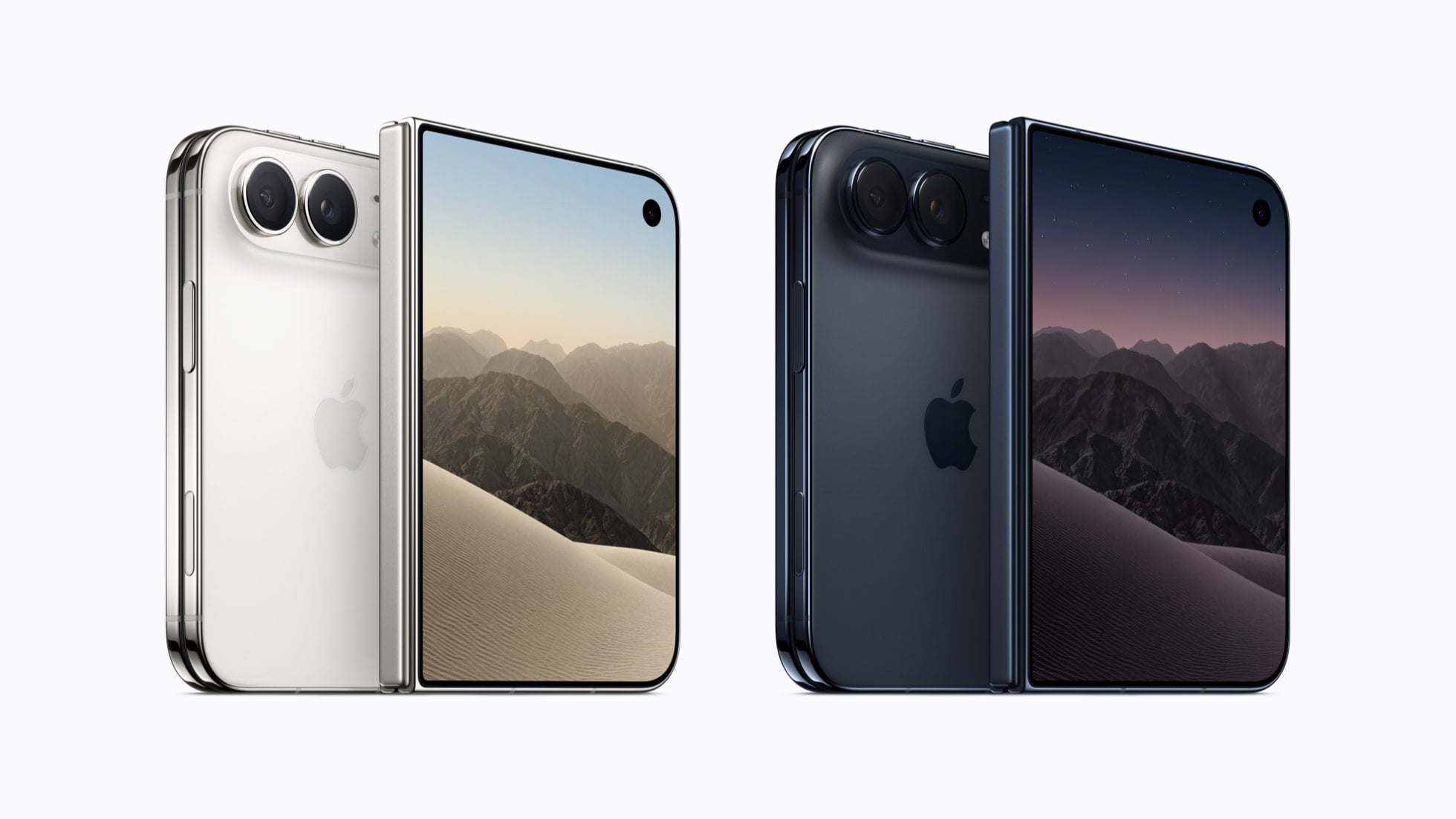
The frame and the 3D-printed hinge cover are grade 5 titanium, the enclosure mirror-polished and the hinge cover finished in a contrasting micro-blasted texture. Apple engineers the hinge from more than 100 components to control opening and closing and to support the center of the display.
Ceramic Shield 2 on the front has 3x better scratch resistance than the previous generation of Ceramic Shield, and Ceramic Shield protects the back. A scratch-resistant coating covers the inner display. Water and dust resistance is rated IP68 under IEC standard 60529, to a maximum depth of 6 meters for up to 30 minutes.
Price, storage and how to pay
Storage steps up in uneven jumps: $200 to 512GB, $400 to 1TB, then $600 to 2TB.
Price picker: choose a storage tier to see the US price, the India price and the Apple Upgrade monthly figure.
The India buy page lists Maximum Retail Price inclusive of all taxes, and quotes every figure with instant cashback and No Cost EMI.
US dollars and Indian rupees by capacity
| Storage | US price | India price |
|---|---|---|
| 256GB | $1,999.00 | ₹299900.00 |
| 512GB | $2,199.00 | ₹324900.00 |
| 1TB | $2,599.00 | ₹374900.00 |
| 2TB | $3,199.00 | ₹449900.00 |
Apple also quotes the entry model at $83.29 (U.S.) per month for 24 months. Apple Upgrade, its leasing program provided by Klarna Inc., runs 12- and 24-month terms and starts as low as $57.99 (U.S.) per month for 24 months. Neither the cashback nor the EMI framing appears on the US buy page.
Trade-in credit varies with the condition, year and configuration of the device you hand over, and is set on receipt of a qualifying device matching the estimate. Apple ties its own service offers to the purchase: AppleCare+ and AppleCare One, iCloud+ from $0.99 a month, and three months of Apple One free.
Dates and countries
Apple says iPhone Duo will be available with iOS 27.1.
Key dates: announced September 9, pre-orders October 16 at 5 a.m. PT, in stores October 23, second wave October 30.
Pre-orders open at 5:00 a.m. PT on Friday, October 16, 2026, or 5:30 PM IST in India, and the phone goes on sale Friday, October 23, 2026. Apple counts more than 70 countries and regions in that first wave and names Australia, Brazil, Canada, China, Colombia, France, Germany, India, Japan, Malaysia, Mexico, Singapore, South Korea, Türkiye, the UAE, the UK, the U.S. and Vietnam among them. 28 other countries and regions follow from Friday, October 30, 2026.
Chip, modem and wireless
iPhone Duo runs on A20 Pro, the same chip as iPhone 18 Pro models.
A20 Pro, N1, C2 and satellite features
| Part | What it is |
|---|---|
| Chip | A20 Pro on 2-nanometer process technology: 6-core CPU (2 super cores, 4 efficiency cores), 7-core GPU with Neural Accelerators, Dual 16-core Neural Engine, hardware-accelerated ray tracing. CPU up to 20 percent faster than A19 Pro, GPU up to 40 percent faster and more power efficient, 2x Neural Engine compute for on-device AI, 50 percent more unified memory bandwidth |
| Sustained performance | Up to 35 percent better than iPhone 17 Pro |
| Wireless | N1 networking chip: Wi-Fi 7 (802.11be) with 2×2 MIMO, Bluetooth 6, Thread. Plus Apple’s second-generation Ultra Wideband chip |
| Cellular | C2 next-generation modem with AI-powered quality and reliability gains, 5G (sub-6 GHz and mmWave) with 4×4 MIMO, Gigabit LTE with 4×4 MIMO, mmWave in the US, NFC with reader mode, Express Cards with power reserve |
| Satellite | Emergency SOS, Roadside Assistance, Messages and Find My via satellite, free for two years with activation of any iPhone 14 or later, connectivity by Globalstar. Crash Detection needs cellular, satellite or Wi-Fi calling |
| Location | Precision dual-frequency GPS (GPS, GLONASS, Galileo, QZSS, BeiDou, NavIC), digital compass, Wi-Fi, cellular, iBeacon microlocation |
A chip package inspired by M-series Apple silicon connects A20 Pro directly to a custom vapor chamber. Apple credits that thermal system for the phone’s pro performance.
eSIM only, everywhere
There is no SIM tray. iPhone Duo is eSIM-only worldwide and is not compatible with physical SIM cards. Apple’s stated reason is space: the design “saves internal space to maximize battery capacity.”
The phone runs dual eSIM, with two lines active at once and eight or more profiles stored, so a home plan and a set of travel plans sit on the device together. eSIM is an industry standard that Apple says is supported by over 500 carriers around the world. One feature is carrier-gated at launch: iPhone Handoff, which moves one phone number between two iPhone models, arrives with T-Mobile in the US and Telekom Germany in Germany.
Battery and charging
Apple quotes separate battery hours for the outer display and the inner display, plus a typical-use figure with both displays used equally.
Quoted hours by display and scenario
| Scenario | Outer display | Inner display | Both displays used equally |
|---|---|---|---|
| Video playback | Up to 44 hours | Up to 31 hours | Not quoted |
| Video playback (streamed) | Up to 37 hours | Up to 26 hours | Not quoted |
| Typical use | Not quoted | Not quoted | Up to 24 hours |
Those hours come off two cells, not one. Apple fits “one high-energy battery on each side to maximize capacity while efficiently using internal space,” and says Apple silicon and energy rebalancing algorithms let the pair operate as one.
Wired and wireless speeds, and what they need
| Method | Claim | What you need |
|---|---|---|
| Wired fast charge | Up to 50% charge in around 20 minutes | 60W-capable adapter or higher (available separately) with a USB-C charging cable |
| Wireless fast charge | Up to 50% charge in around 30 minutes | 35W adapter or higher with a MagSafe Charger (both available separately) |
| Wireless maximum | MagSafe up to 25W, Qi2 up to 25W | MagSafe or Qi2 charger |
None of those claims works with what is in the box: an iPhone with iOS 27 and a USB-C Charge Cable (1 m). The adapter is a separate purchase.
Battery figures: pick an activity and a display to compare Apple’s stated hours, with the two charging claims underneath.
Adapter wattage decides which fast-charge claim you can hit.
Cameras
iPhone Duo carries a 48MP Dual Fusion camera system on the back.
Rear lenses, apertures and stabilization
| Camera | Resolution | Focal length | Aperture | Stabilization and focus |
|---|---|---|---|---|
| Fusion Main | 48MP | 26 mm | ƒ/1.6 | Sensor-shift optical image stabilization, Hybrid Focus Pixels |
| 2x Telephoto (optical quality, from Main) | 12MP | 52 mm | ƒ/1.6 | Sensor-shift optical image stabilization, Hybrid Focus Pixels |
| Fusion Ultra Wide | 48MP | 13 mm, 120° field of view | ƒ/2.2 | Hybrid Focus Pixels |
Apple counts that as a 4x optical-quality zoom range, shot at 0.5x, 1x and 2x, with digital zoom to 10x.
Lens picker: choose a lens to see its focal length, aperture and field of view drawn to angle.
Video comes off the same two rear cameras, in HEVC and H.264, with digital zoom to 6x.
What each video recording mode can do
| Video | What it does |
|---|---|
| Max resolution | 4K Dolby Vision at 24, 25, 30, 60, 100 or 120 fps, the last two on Fusion Main; 1080p Dolby Vision at 25, 30 or 60 fps, and 120 fps on Fusion Main |
| Slow motion | 1080p up to 240 fps, 4K Dolby Vision up to 120 fps on Fusion Main |
| Cinematic mode | Up to 4K Dolby Vision at 60 fps, and it can pull cinematic effects from existing video |
| Action mode | Up to 2.8K Dolby Vision at 60 fps |
| Dual Capture | Up to 4K Dolby Vision at 30 fps |
Two front cameras sit on the phone. The outer one is a 12MP Center Stage camera at ƒ/2.2 with Retina Flash, Center Stage for photos and video calls, ultra-stabilized video, and 4K Dolby Vision recording at up to 60 fps. Under the inner display sits a separate FaceTime camera at ƒ/1.8, with Center Stage for video calls, tap to zoom and rotate, Animoji and Memoji in FaceTime, and 1080p recording at 30 or 60 fps.
Four camera features come from the foldable design and its second screen:
- Smart Take: the phone works out when everyone is ready and takes the picture, so nobody has to race a timer.
- Duo Preview: the outer display gives whoever you are photographing a live preview, so they can fix their pose and framing.
- Kid Cue: animations from Peanuts play on the outer display to draw a child’s eyes toward the lens.
- Duo FaceTime: friends next to you join the call on the outer display instead of crowding around one screen.
Photographic Styles 3 adds texture and grain controls on top of tone and color, for smoothing out skin detail or for an artful film look.
iOS 27 on iPhone Duo
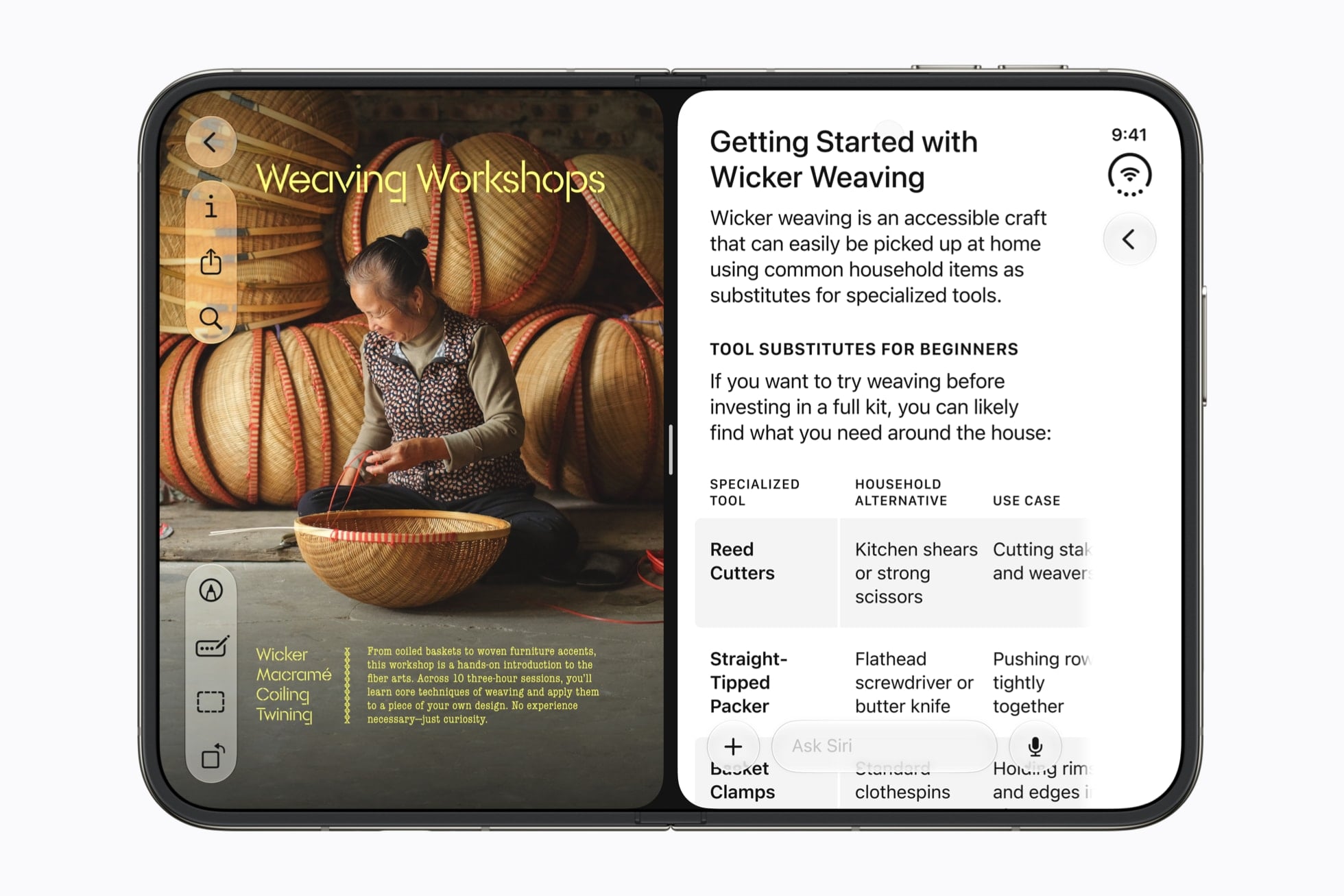
Open the phone and the Home Screen shows two pages at once, with Today View scrolling vertically down the left.
Side controls, Split View, StandBy and unlock
| Feature | What changes on iPhone Duo |
|---|---|
| Side controls and vertical dock | Lock Screen controls, Dock and in-app navigation move to the side for vertical space, and the Dynamic Island runs vertically on both displays |
| Split View and app pairing | Two apps side by side on iPhone for the first time, two windows of one app included, and pairs can be saved |
| StandBy without a charger | Either display enters StandBy off the charger, with new Calendar and Weather faces |
| Touch ID and Apple Watch unlock | Touch ID sits in the side button and works open or closed, and an Apple Watch unlocks the phone too |
| Camera Control and Siri Camera mode | Camera Control opens the camera fast, and Siri Camera mode lets Siri see what you see |
| Apple Intelligence and Siri AI | 16 languages; Siri AI in beta, English to start, with French, Japanese, Korean, Portuguese and Spanish in October, not in the EU on iOS initially, not for under-13s, daily limits on some server features |
Content reacts as the phone folds, reorients when it is turned on its side, and switches to the appropriate display when flipped over.
Tap-to-expand cards for the six iOS 27 changes made for the folding screen.
What you give up versus iPhone 18 Pro Max
Both phones run the same A20 Pro chip. Apple quotes a smaller sustained-performance gain for Duo, up to 35 percent over iPhone 17 Pro, than for iPhone 18 Pro, up to 40 percent over the previous generation. What Duo gives up is the Pro camera and video stack, and Face ID.
Comparison table: filter the iPhone Duo versus iPhone 18 Pro Max rows down to only what Duo lacks, or to the camera rows.
What iPhone Duo has that iPhone 18 Pro Max does not
What Duo adds is a second display, an under-display FaceTime camera, Apple Pencil (USB-C) support, dual batteries, four ambient light sensors, and Smart Take, Duo Preview, Kid Cue and Duo FaceTime.
Every Pro feature and what replaces it
| iPhone 18 Pro Max has | iPhone Duo has instead |
|---|---|
| Face ID, enabled by TrueDepth technology | Touch ID, built into the side button |
| 48MP Fusion Telephoto, 16x optical-quality zoom range (8x in, 2x out) | 48MP Dual Fusion, 4x optical-quality zoom range (2x in, 2x out) |
| ƒ/1.48, ƒ/1.8, ƒ/2.8, ƒ/4.0 variable aperture on Fusion Main | Fixed ƒ/1.6 Fusion Main |
| Pro controls for aperture, shutter speed, white balance and histogram | Standard Camera controls (Exposure, Depth, Zoom, Cameras, Styles, Tone) |
| Action button | Camera Control, volume and side buttons only |
| LiDAR Scanner | No LiDAR Scanner |
| ProRAW, ProRes up to 4K at 120 fps, ProRes RAW, Apple Log 2 | HEIF and JPEG photos, HEVC and H.264 video |
| Spatial photos and spatial video at 1080p at 30 fps | Dual Capture up to 4K Dolby Vision at 30 fps |
| Apple Reference Image (Fusion Main) | Photographic Styles 3 with texture and grain |
| 18MP Center Stage front camera | 12MP Center Stage front camera plus an under-display FaceTime camera |
Storage: how much is really yours
iOS 27 and the Apple Intelligence models take their share of every capacity before you add anything.
Storage calculator: pick a tier to see how much of it iOS 27 and the Apple Intelligence models take, and what is left.
A standard configuration uses approximately 12GB to 24GB of space, covering iOS 27 with its latest features plus Apple apps that can be deleted. The Apple Intelligence on-device models use approximately 7GB more and can be deleted if Apple Intelligence is turned off, and the deletable Apple apps use about 4.5GB.
Accessories
Case and Folio prices and colors
| Accessory | US price | Colors |
|---|---|---|
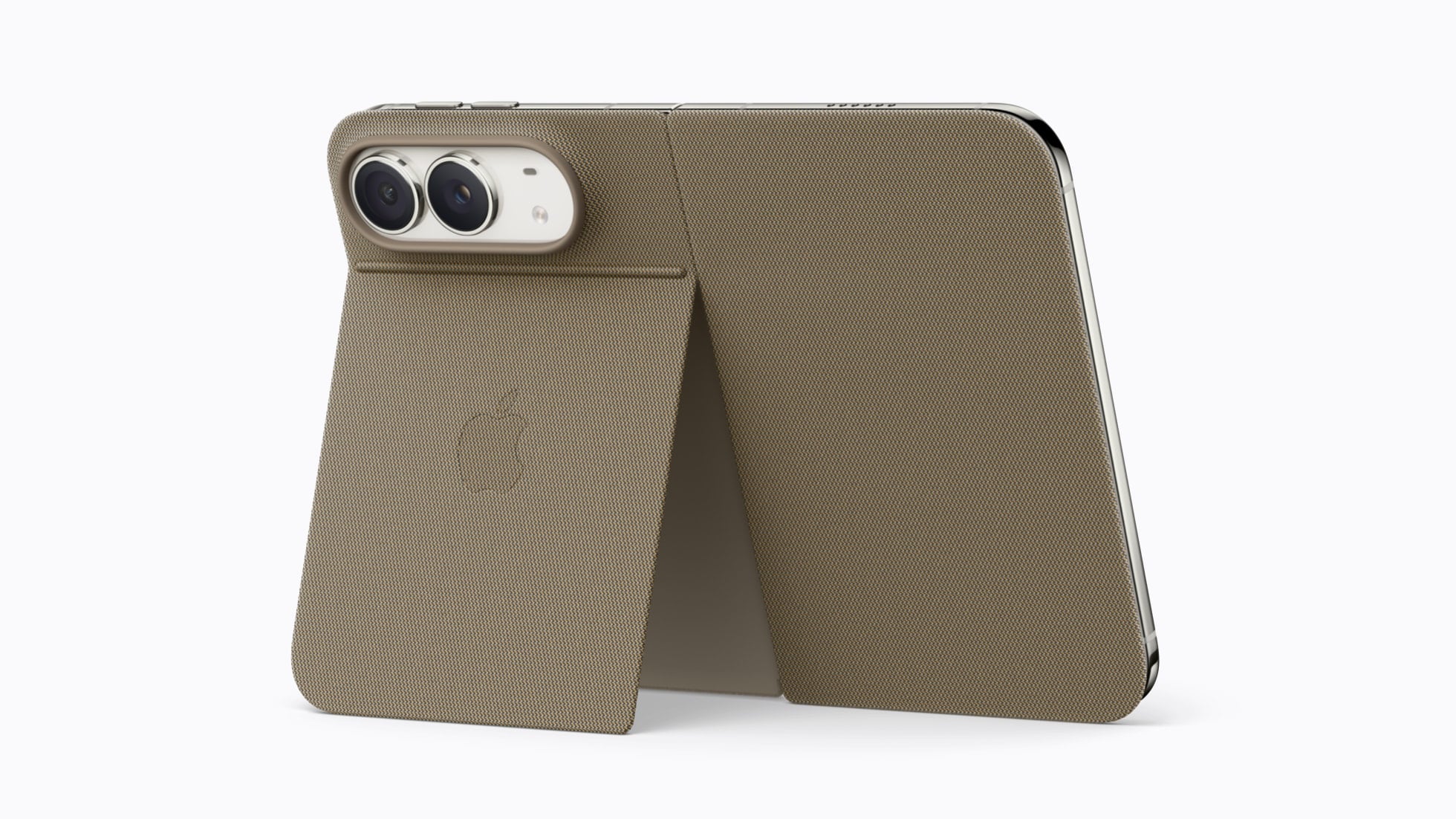
| iPhone Duo Case | $79 | Navy blue, sand |
| iPhone Duo Folio with Kickstand | $129 | Navy blue, taupe |
Both are available to order from Friday, October 16, 2026, and both work with MagSafe, Qi2 25W and Qi-certified chargers. The Folio’s integrated kickstand supports a range of angles for reading, viewing content or FaceTime, and folds away when it is not in use.
FAQs
Is there a SIM tray?
No. iPhone 14 models and later are activated with an eSIM and do not support a physical SIM. Using one needs a carrier that supports eSIM and a wireless service plan.
Does the inner display show a crease?
High-strength glass sits above and below the folding panel, with custom adhesives that let the layers glide past one another like the pages of a book, relieving bend stress. A nano-textured cover layer, a custom polymer up to 40 percent stiffer than other materials used in the industry, sits on top, with a titanium plate at the bottom.
Does it use Face ID or Touch ID?
Touch ID, built into the side button. Apple’s sensor list also carries a barometer, a high dynamic range gyro, a high-g accelerometer, a proximity sensor and four ambient light sensors, twice as many as iPhone 18 Pro Max.
What charger do I need for the 20-minute claim?
A 60W-capable adapter or higher with a USB-C charging cable. Apple’s own test ran on its 40W Dynamic Power Adapter with 60W Max, with drained units in the open position, timed from the moment the Apple logo appears. Charge time varies with adapter, settings, usage and environment.
Does it work with Apple Pencil?
Yes, with Apple Pencil (USB-C), on either display, coming later this year. No other iPhone in Apple’s seven-model comparison lists Apple Pencil support.
Is it water resistant?
Yes, rated IP68 under IEC standard 60529. Apple adds that splash, water and dust resistance are not permanent conditions and can decrease with normal wear, that you should not charge a wet iPhone, and that liquid damage is not covered under warranty.
Related guides


Leave a Reply