
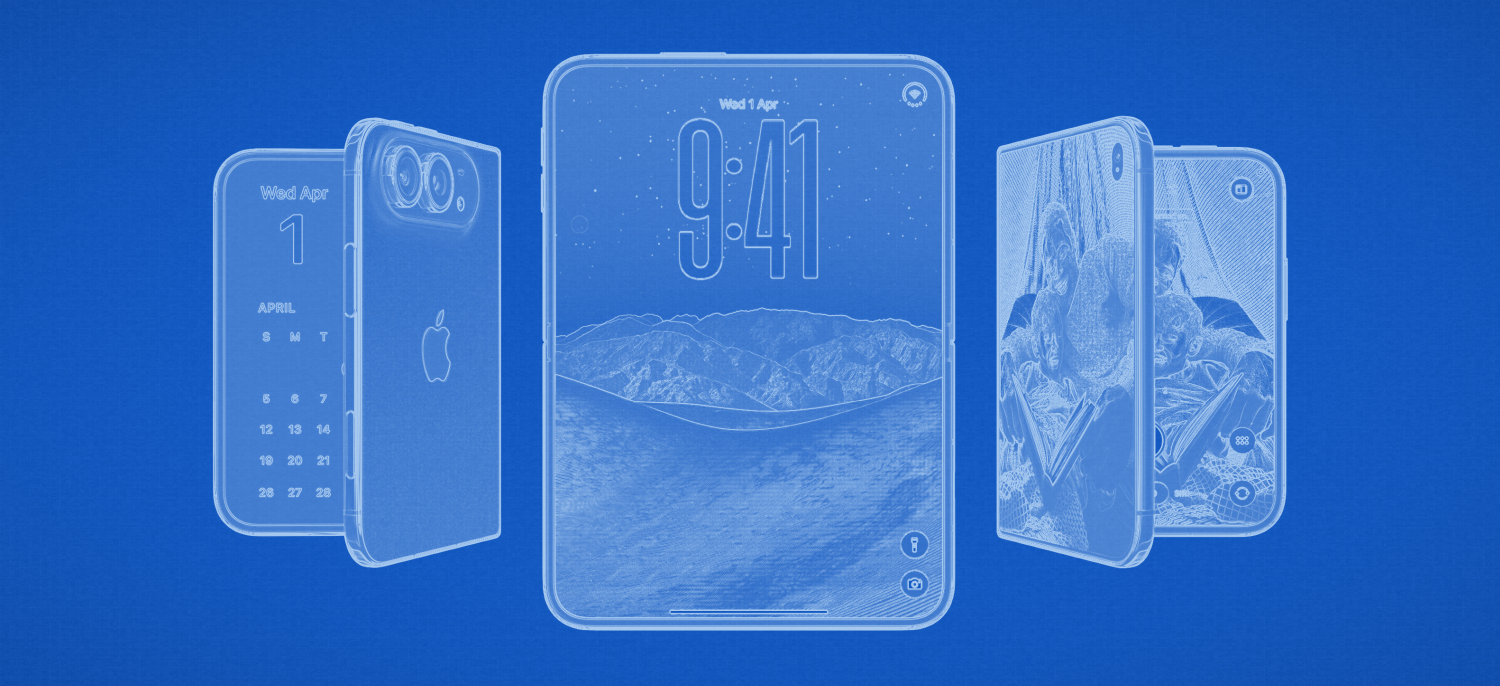
- The short version
- All Apple’s iPhone Duo tech specs (select from dropdown)
- Finish, capacity, and physical dimensions
- Inner display, outer display, and shared features
- Camera hardware, recording modes, and capture formats
- Battery life, charging, and test conditions
- Wireless connectivity, location, eSIM, and safety features
- USB-C functions and media playback
- Sensors and Touch ID placement
- Resistance, operating limits, and box contents
- FAQs
The short version
- iPhone Duo lists rectangular display diagonals of 7.58 and 5.36 inches, USB 3 up to 10Gb/s, and separate battery ratings for each display.
- The rear camera system pairs a 48MP Fusion Main camera with a 48MP Fusion Ultra Wide camera.
- Storage options are 256GB, 512GB, 1TB, and 2TB.
iPhone Duo’s dimensions change between open and closed configurations. Camera recording modes have their own resolution and frame-rate limits, while battery and charging claims apply to specific test conditions.
All Apple’s iPhone Duo tech specs (select from dropdown)
Spec finder: pick a section of Apple’s iPhone Duo tech specs to see the entries it holds and the footnote Apple attaches to each one.
Every headline figure on the spec page has a footnote attached, and the footnotes are where the conditions live.
Finish, capacity, and physical dimensions
iPhone Duo combines a foldable titanium design with separate front and back protection.
Colors, construction, and storage options
| Specification | Value |
|---|---|
| Finish | Night Sky, Star White |
| Design | Titanium foldable design |
| Front | Ceramic Shield 2 |
| Back | Ceramic Shield |
| Capacity | 256GB, 512GB, 1TB, 2TB |
Size and weight vary by configuration and manufacturing process, as qualified in footnote 2.
Open and closed measurements
| Measurement | Open | Closed |
|---|---|---|
| Width | 6.48 inches (164.6 mm) | 3.31 inches (84.1 mm) |
| Height | 4.64 inches (117.8 mm) | 4.64 inches (117.8 mm) |
| Depth | 0.21 inch (5.2 mm) | 0.44 inch (11.3 mm) |
| Weight | 8.96 ounces (254 grams) | 8.96 ounces (254 grams) |
The inner display has a Nano-texture finish to reduce glare and Wide-angle OLEDs for viewing at an angle. Both screens have rounded corners within their standard rectangular measurements, so actual viewable area is less.
Screen sizes and pixel densities
| Display specification | Inner display | Outer display |
|---|---|---|
| Display family | Super Retina XDR display | Super Retina XDR display |
| Panel | 7.6-inch diagonal all-screen OLED folding display | 5.4-inch diagonal all-screen OLED display |
| Standard rectangular diagonal | 7.58 inches | 5.36 inches |
| Resolution | 1878-by-2670 pixels | 1398-by-2034 pixels |
| Pixel density | 430 ppi | 460 ppi |
The displays share the same aspect ratio, allowing content to scale proportionally between them.
Features supported by both screens
| Shared display entry | Specification |
|---|---|
| Interface and persistent display | Dynamic Island; Always-On display |
| Refresh rate | ProMotion technology with adaptive refresh rates up to 120Hz |
| HDR and color | HDR display; True Tone; Wide color (P3) |
| Touch response | Haptic Touch |
| Contrast ratio | 2,000,000:1 typical |
| Typical brightness | 1000 nits max |
| HDR brightness | 1600 nits peak |
| Outdoor brightness | 3000 nits peak |
| Minimum brightness | 1 nit |
| Coatings | Fingerprint-resistant oleophobic coating; Anti-reflective coating |
| Language display | Support for display of multiple languages and characters simultaneously |
Camera hardware, recording modes, and capture formats
The optical-quality 2x Telephoto capability comes from the Fusion Main camera.
Rear and front camera hardware
| Camera | Hardware specification |
|---|---|
| 48MP Fusion Main | 26 mm; ƒ/1.6 aperture; sensor-shift optical image stabilization; Hybrid Focus Pixels; super-high-resolution photos at 24MP and 48MP. Also enables 12MP optical-quality 2x Telephoto at 52 mm, with ƒ/1.6 aperture, sensor-shift optical image stabilization, and Hybrid Focus Pixels. |
| 48MP Fusion Ultra Wide | 13 mm; ƒ/2.2 aperture; 120° field of view; Hybrid Focus Pixels; super-high-resolution photos at 24MP and 48MP |
| Outer front camera | 12MP Center Stage camera; ƒ/2.2 aperture |
| Inner front camera | Under-display FaceTime camera; ƒ/1.8 aperture |
Rear photography supports 2x optical-quality zoom in, 2x optical zoom out, a 4x optical-quality zoom range, and digital zoom up to 10x. Other still-photo capabilities include 48MP macro photography and panoramas up to 63MP.
Rear video supports macro recording, including slo-mo and time-lapse, plus Night mode Time-lapse. Sensor-shift optical image stabilization for video applies to Fusion Main. The outer front camera includes Ultra-stabilized video, Dual Capture, and Night mode Time-lapse; the inner front camera also supports Ultra-stabilized video.
Recording resolutions and frame rates
| Camera scope | Recording mode | Resolution and frame rates |
|---|---|---|
| Rear | 4K Dolby Vision | 24, 25, 30, or 60 fps; 100 or 120 fps on Fusion Main |
| Rear | 1080p Dolby Vision | 25, 30, or 60 fps; 120 fps on Fusion Main |
| Rear | 720p Dolby Vision | 30 fps |
| Rear | Cinematic mode | Up to 4K Dolby Vision at 60 fps |
| Rear | Action mode | Up to 2.8K Dolby Vision at 60 fps |
| Rear | Slo-mo | 1080p up to 240 fps; 4K Dolby Vision up to 120 fps on Fusion Main |
| Rear | Dual Capture | Up to 4K Dolby Vision at 30 fps |
| Rear | Time-lapse with stabilization | Up to 4K Dolby Vision |
| Rear | QuickTake | Up to 4K Dolby Vision at 60 fps |
| Outer front | 4K Dolby Vision | 24, 25, 30, or 60 fps |
| Outer front | 1080p Dolby Vision | 25, 30, or 60 fps |
| Outer front | Cinematic mode | Up to 4K Dolby Vision at 30 fps |
| Outer front | Slo-mo | 1080p at 120 fps |
| Outer front | Time-lapse with stabilization | Up to 4K Dolby Vision |
| Outer front | QuickTake | Up to 4K at 60 fps in Dolby Vision |
| Inner front | Video recording | 1080p at 30 or 60 fps |
| Inner front | QuickTake | 1080p at 30 and 60 fps |
The rear and outer front camera entries also include Wind noise reduction and Audio Mix. Rear video adds Audio zoom.
Photo, video, and audio capture
| Capture entry | Specification |
|---|---|
| Image formats captured | HEIF and JPEG |
| Video formats recorded | HEVC and H.264 |
| Rear video digital zoom | Up to 6x |
| Still photos during rear 4K recording | 8MP |
| Rear audio recording | Spatial Audio and stereo recording |
| Outer front audio recording | Spatial Audio and stereo recording |
Battery life, charging, and test conditions
iPhone Duo uses dual built-in rechargeable lithium-ion batteries. Apple’s typical-use rating combines activity across both displays, while playback ratings distinguish which display is in use.
Apple’s battery life ratings
| Battery-use condition | Rating |
|---|---|
| Typical use | Up to 24 hours |
| Video playback, outer display | Up to 44 hours |
| Video playback, inner display | Up to 31 hours |
| Streamed video playback, outer display | Up to 37 hours |
| Streamed video playback, inner display | Up to 26 hours |
Actual battery life varies with use, configuration, cellular network, signal strength, and other factors under footnote 6. Charging results vary with the adapter, settings, usage, and environmental factors under footnote 8.
Charging power and accessory requirements
| Charging entry | Specification |
|---|---|
| Wired fast charging | Up to 50% charge in around 20 minutes with a 60W-capable adapter or higher, available separately, paired with a USB-C charging cable |
| MagSafe fast charging | Up to 50% charge in around 30 minutes with a 35W adapter or higher paired with a MagSafe Charger; both available separately |
| MagSafe wireless charging | Up to 25W |
| Qi2 wireless charging | Up to 25W |
| MagSafe hardware | Magnet array; Alignment magnet; Accessory Identification NFC; Magnetometer |
Apple tested typical use in August 2026 and playback and fast charging in July 2026. These tests used preproduction hardware and software.
Usage profiles and charging setup
| Battery test | Conditions |
|---|---|
| Typical use, footnote 6 | LTE and 5G carrier networks. A representative profile based on median iPhone usage combined passive and active applications, including messaging, photos, music, social media, video streaming, games, web browsing, and navigation. Equal usage between inner and outer displays. |
| Playback, footnote 7 | LTE and 5G carrier networks. Video playback repeated a 2-hour 23-minute HDR movie purchased from the iTunes Store. Streamed playback repeated a 3-hour 1-minute HDR movie purchased from the iTunes Store. Default settings except Bluetooth paired with headphones, Wi-Fi associated with a network, and Ask to Join Networks, Auto-Brightness, and True Tone turned off. |
| Fast charging, footnote 8 | USB-C Charge Cable or Apple MagSafe Chargers: 1-meter Model A3502 and 2-meter Model A3503. Both charging setups used the Apple 40W Dynamic Power Adapter with 60W Max, Model A3351. Wired fast charging supported with a 60W-capable or higher USB-C cable and USB PD power adapters. Units were drained and open. Elapsed time began when the Apple logo appeared during startup. |
Wireless connectivity, location, eSIM, and safety features
The cellular specifications identify iPhone Duo model A3447. Footnote 11 requires a data plan and limits availability of 5G, Gigabit LTE, VoLTE, and Wi-Fi calling to supported markets and carriers. Cellular speeds are theoretical and vary with site conditions and carrier.
Networks, positioning, and emergency connectivity
| Connectivity entry | Specification |
|---|---|
| 5G | Sub-6 GHz and mmWave with 4×4 MIMO |
| LTE | Gigabit LTE with 4×4 MIMO |
| Wireless networking chip | Apple N1 |
| Wi-Fi | Wi-Fi 7 (802.11be) with 2×2 MIMO |
| Bluetooth | Bluetooth 6 |
| Thread | Thread networking technology |
| Ultra Wideband | Apple second-generation Ultra Wideband chip |
| NFC | NFC with reader mode |
| Express Cards | Express Cards with power reserve |
| Cellular modem | Apple C2 |
| Satellite positioning | Precision dual-frequency GPS: GPS, GLONASS, Galileo, QZSS, BeiDou, and NavIC |
| Other location technologies | Digital compass; Wi-Fi; Cellular; iBeacon microlocation |
| SIM Card | Dual eSIM: two active eSIMs; stores eight or more eSIMs. No physical SIM compatibility. |
| Satellite features | Emergency SOS via satellite; Roadside Assistance via satellite; Messages via satellite; Find My via satellite |
| Crash Detection | Detects a severe car crash and can call for help; requires a cellular connection, satellite connectivity, or Wi-Fi calling |
Wi-Fi 7 availability depends on country or region under footnote 12. Ultra Wideband availability varies by region under footnote 13.
Activation uses eSIM, which requires a carrier that supports eSIM and a wireless service plan under footnote 15. Satellite connection and response times vary with location, site conditions, and other factors; connectivity is provided by Globalstar and its affiliates.
USB-C functions and media playback
The USB-C connector handles charging, display output, and data transfer. Footnote 14 requires a USB 3 cable with 10Gb/s speed for the stated data-transfer capability.
Connector functions and transfer speed
| USB-C function | Specification |
|---|---|
| Power | Charging |
| Display connection | DisplayPort |
| Data transfer | USB 3, up to 10Gb/s |
Audio playback includes Spatial Audio playback and a User-configurable maximum volume limit.
Playback formats and display output
| Playback entry | Supported formats or output |
|---|---|
| Audio formats | Include AAC, APAC, MP3, Apple Lossless, FLAC, Dolby Digital, Dolby Digital Plus, and Dolby Atmos |
| Video formats | Include HEVC, H.264, and AV1 |
| HDR formats | Dolby Vision, HDR10+/HDR10, and HLG |
| AirPlay | Up to 4K HDR for mirroring, photos, and video out to Apple TV (2nd generation or later) or an AirPlay-enabled smart TV |
| Native DisplayPort over USB-C | Up to 4K HDR for video mirroring and video out |
Sensors and Touch ID placement
The Touch ID fingerprint sensor is built into the side button.
The remaining Sensors entries are Barometer; High dynamic range gyro; High-g accelerometer; Proximity sensor; and Four ambient light sensors.
Resistance, operating limits, and box contents
iPhone Duo was tested for splash, water, and dust resistance under controlled laboratory conditions. Resistance is not permanent and can decrease with normal wear. Do not charge a wet iPhone; follow the user guide’s cleaning and drying instructions.
Resistance rating and environmental limits
| Environmental entry | Specification |
|---|---|
| Splash, water, and dust resistance | IP68 under IEC standard 60529; maximum depth of 6 meters for up to 30 minutes |
| Operating ambient temperature | 32° to 95° F (0° to 35° C) |
| Nonoperating temperature | −4° to 113° F (−20° to 45° C) |
| Relative humidity | 5% to 95% noncondensing |
| Operating altitude | Tested up to 10,000 feet (3000 m) |
The In the Box inventory is iPhone with iOS 27 and a USB-C Charge Cable (1 m). The Operating System entry also names iOS 27. Apple specifies availability with iOS 27.1.
FAQs
Why is available storage lower than the stated capacity?
Footnote 1 says a standard configuration uses approximately 12GB to 24GB, including iOS 27 and deletable Apple apps. Apple Intelligence on-device models use approximately 7GB; turning Apple Intelligence off lets you delete those models, and turning it on downloads them again. Deletable Apple apps occupy about 4.5GB and can be downloaded again from the App Store. Available space varies with software version, settings, and iPhone model, so these figures do not establish a fixed amount of free storage.
When will Apple Pencil (USB-C) support be available?
Apple Pencil (USB-C) support is coming later this year, per footnote 3. Support covers both the inner and outer displays.
Are satellite features free, and can other charges apply?
Footnote 9 includes satellite features free for two years with activation of any iPhone 14 or later model. Some features require a carrier plan. SMS messaging via satellite requires a supported carrier, and SMS message rates may apply. Roadside assistance provider fees vary with location and the type of assistance.
Does water resistance include warranty coverage for liquid damage?
Liquid damage is not covered under warranty, as stated in footnote 4.
What does the USB-C Digital AV Adapter footnote mean for video output?
The USB-C Digital AV Adapter, model A2119, is sold separately. Although Apple groups it under up to 4K HDR video output, its attached footnote 21 limits the adapter to standard dynamic range video content only.
Related guides




Leave a Reply