

Hathor is best used as a safe late-game auction assistant: survive to Round 5, combine her full-rarity reveal with silhouette or value devices, then bid just under the estimated case value to win profitably.
Hathor turns Going, Going, Gone into an information game. Her best auctions are not won by guessing early; they are won by reaching the final reveal with enough device data to price the display case better than the other bidders.
The clean Hathor plan is simple: spend the first four rounds scouting, keep your bid from getting reckless, then use Round 5 to decide whether the case still has profit in it.
Hathor’s Round 5 role

Use Hathor when you are comfortable playing the auction defensively for several rounds. Her assistant skill reveals the rarity of all collectibles at the start of Round 5, so she gives very little immediate pressure in Rounds 1-4.
KEY!That timing makes her a late-game assistant, not an early snowball pick. The goal is to reach Round 5 with extra information already banked: silhouettes, public collectible info, value reads, appraisal results, and opponent bidding patterns.
Because device effects are consumed when used, early rounds should be about staying alive in the auction. If the case does not show a premium pattern yet, keep the bid active enough to move forward without trapping yourself above the likely case value.
Do not chase a case before Round 5 unless a premium item is already showing. Hathor earns her value when the final rarity reveal can correct your bid.
Device sets for Hathor runs
| Device set | Best use |
|---|---|
| Advanced General-Purpose Device Set | Cost-efficient Hathor setup when listed at 20,000 shells; use it to gather practical rarity, size, and silhouette info without feeling forced to win early. |
| Super Valuation Device Set | Information-heavy setup when listed at 50,000 shells; use it when you have shells to spend and want stronger early appraisal or value reads. |
The device set decides how much early information you can buy before Hathor’s skill comes online. The cheaper route works well when you want enough scouting to survive; the expensive route makes sense when you are willing to pay for stronger early reads and possible early pressure.
Both sets work because Hathor does not need one perfect device. She needs enough partial information for her Round 5 rarity reveal to turn the case from a guess into a priced bid.
How to predict Hathor auction values in Neverness to Everness
Use Rounds 1-4 to build a value picture without overpaying, then make the Round 5 bid from rarity, silhouette, and opponent behavior.
STEP 1/12
Select Hathor as the auction assistant

Pick Hathor when your plan is to reach Round 5, because her assistant skill reveals every collectible rarity at that point.
STEP 2/12
Choose the device set for your budget

Use the general-purpose set for a lower-pressure run or the Super Valuation Device Set when you want more early information.
STEP 3/12
Start with size or appraisal info

Use early scouting to look for valuable collectibles such as Special Coin Pile.
STEP 4/12
Add evaluation before raising hard

Use an evaluation device to judge item count, rarity spread, or value signals before committing to a bigger bid.
STEP 5/12
Delay silhouette reveals when possible

Save silhouette information for later rounds if you read rarity better, because it combines more cleanly with Hathor once Round 5 begins.
STEP 6/12
Keep ordinary cases alive cheaply
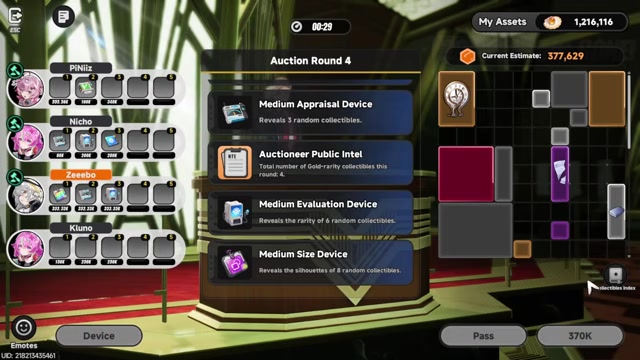
If the early info does not point to a high-value case, stay conservative and avoid locking yourself into a bid the case cannot repay.
STEP 7/12
Merge the Round 5 rarity reveal with prior info
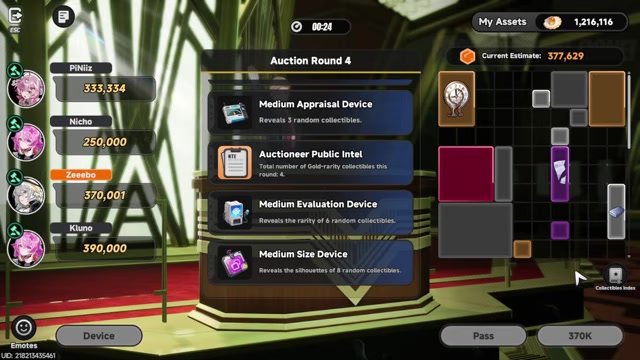
Once Hathor activates, combine rarity, silhouettes, public collectible info, and opponent bids into one case-value estimate.
STEP 8/12
Bid below the profitable estimate
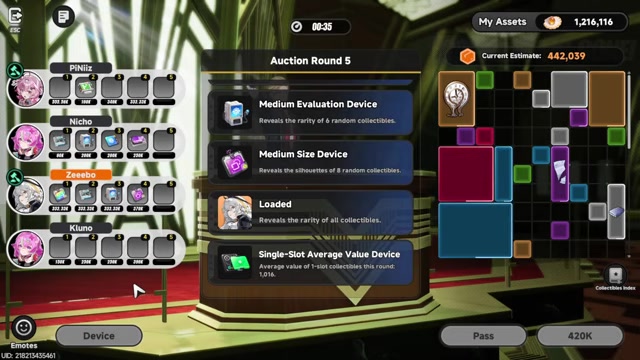
A 420k bid on a 442k estimate is the safe version of the play, where the bid is high enough to compete but still leaves margin.
STEP 9/12

If large appraisal or value tools reveal Flatbread, red items, or a strong bottom row, you can bid aggressively before Round 5.
STEP 10/12
Cut back when the table stays low

If opponents keep bidding much lower, lower your own number while preserving a path into the next round.
STEP 11/12

Count information, such as a large number of purple items still unrevealed, helps decide whether the case can carry a higher bid.
STEP 12/12
Raise only when the final board supports it

An 888k bid around an 880k estimate is the aggressive version, justified only when the revealed board, red-rarity upside, and opponent ceiling line up.
Video help
Aggressive bids on high-value cases
High-value cases are the exception to Hathor’s passive style. When a large appraisal setup exposes premium signs early, like Flatbread, red-rarity items, or strong bottom-row value, you can start forcing the auction before Hathor’s skill activates.
The aggressive line still needs brakes. If more information makes the first pressure bid look too high, or if opponents are staying far below you, pull your number down and keep the auction moving instead of paying for value that may not be there.
Use this style only when the information is real. Large appraisal, large evaluation, and average-value tools give the numeric backing; without them, play for Round 5 and let Hathor do the expensive work at the end.
Hathor bidding decisions
| Situation | Move |
|---|---|
| Info is weak in Rounds 1-4 | Bid only enough to continue the auction and save stronger reads for later. |
| A high-value item appears early | Use appraisal or value info to support a stronger bid before Round 5. |
| Opponents are bidding low | Reduce your number unless your own device info clearly prices the case higher. |
| Round 5 shows clear profit | Bid near the estimated case value while leaving room for shell gain. |
| Earlier bids were too high | Use the final rarity and silhouette picture to lower the bid and limit loss. |
Run this check before locking in a serious bid. Hathor rewards patience, but every aggressive number still needs a revealed premium collectible, a value device, or a Round 5 rarity map behind it.
Frequently Asked Questions
Is Hathor good in Going, Going, Gone?
Yes, Hathor is strong for players who can slow the auction down and read partial information well. She is weaker in auctions that end before Round 5, because her main value has not activated yet.
Why does Hathor need to reach Round 5?
Her assistant skill is tied to Round 5 specifically. Before that point, you are playing mostly with device information and normal bidding reads.
Should I use the 20,000 or 50,000 shell device set with Hathor?
Use the cheaper set when shell recovery matters, especially if you are playing cautiously. Use the expensive set when you want earlier value reads and are comfortable paying more to support aggressive bids.
When should I bid aggressively with Hathor?
Bid aggressively when early devices reveal premium case quality and opponent behavior suggests you can still win without overpaying. If your strong bid is based only on a hunch, wait for Hathor’s Round 5 reveal.
Can Hathor still lose money if the prediction is wrong?
Yes. Hathor reduces the chance of a bad final bid, but she cannot erase an early overbid or a misread silhouette. The safer play is to keep enough flexibility to lower the bid once the Round 5 information appears.




Leave a Reply