
Grappling in EA Sports UFC 6 is won by denying your opponent’s transitions — hold R2 and push the right stick toward the direction they’re moving to block it — while building grapple advantage through well-timed denials and strikes to speed up your own transitions.
Grappling in EA Sports UFC 6 is a positional denial game built on grapple advantage and timing, not button-mashing. The ground game follows a jiu-jitsu positional hierarchy, meaning stronger positions give the bottom player fewer options and slower transitions, while the top player controls the flow. Throughout this guide, we’ll cover how to set up practice drills, the exact denial input, the risks of pre-denying, a position-by-position reference for every ground spot, the clinch, and where to go next.
Settings up practice mode for denial drills
If you’re working on takedown defense without a second player, you can set the AI takedown behavior to focus on driving into the cage or changing direction. This simulates the mix of angles you’ll see in a real fight.
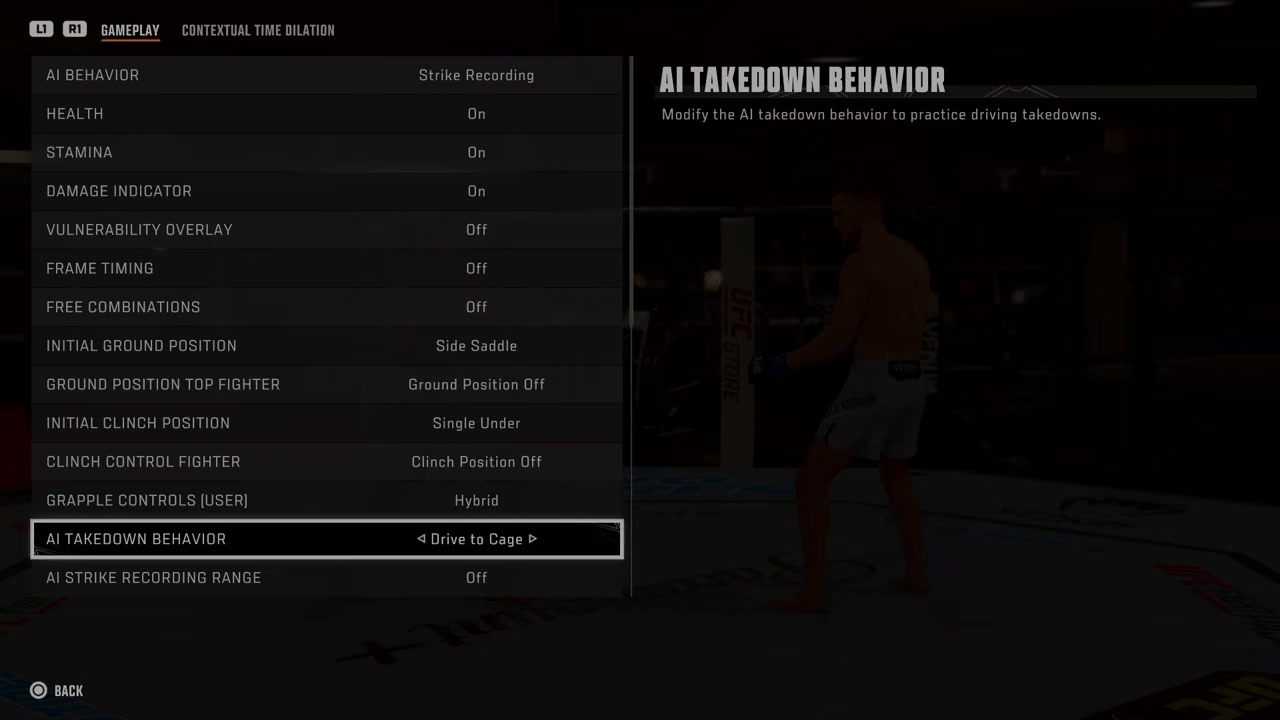
You can also turn on contextual time dilation, which slows the action down to help you learn the timing windows for normal denials, takedown denials, turn denials, and over-under clinch evasion. It’s the single fastest way to internalize the timing without a human partner.
The risk of pre-denying and cage proximity
Pre-denying — guessing a direction and holding your denial early — is one of the most punishing habits you can build. If you pre-deny in a direction and your opponent doesn’t move at all, they start to accumulate grapple advantage for free, which speeds up their next transition. Even worse, if you pre-deny one direction and they go the other way, that transition becomes completely free. You lose the window entirely, and there’s no way to recover it in that split second.
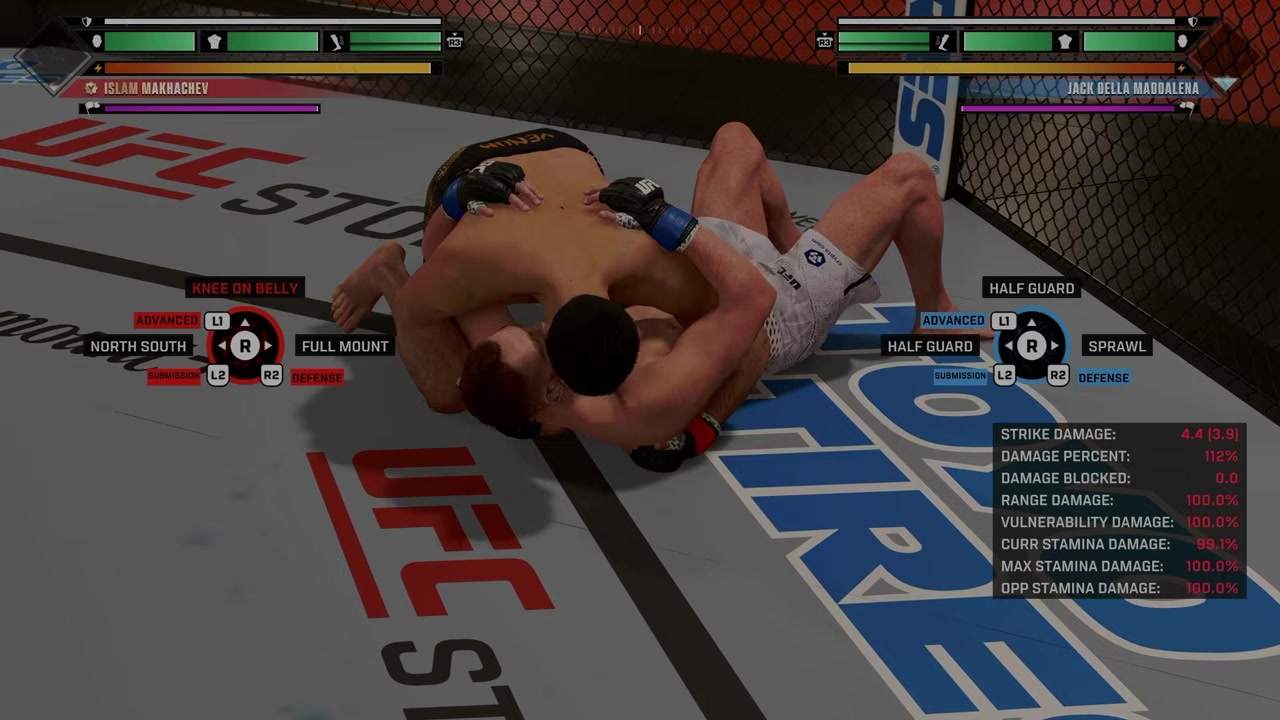
Your position relative to the cage also changes your available options. If you’re in side control near the fence, the bottom player might gain access to a cage butterfly position instead of a standard full guard recovery.
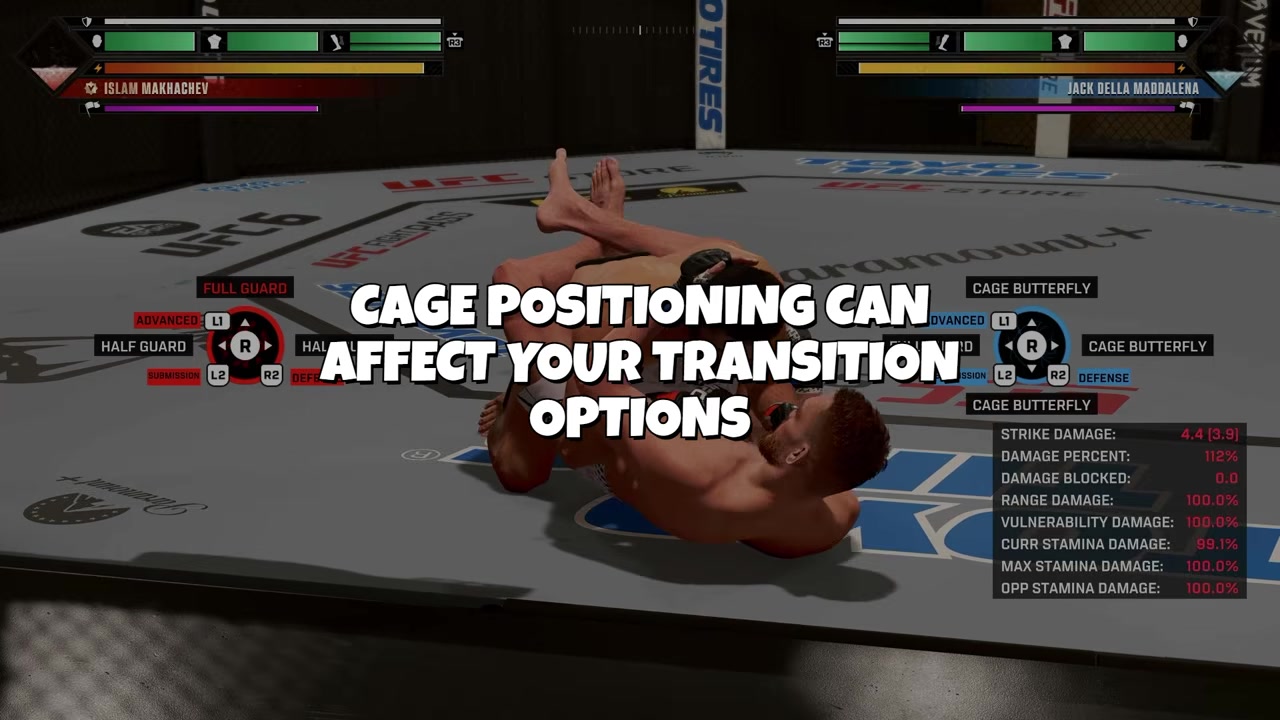
A bottom fighter can also use the cage to wall-walk and reverse the position, flipping the top player over. Always be aware of where you are in the octagon, because the transition options on screen will shift based on cage proximity.
Ground positions, denial directions, and options
| Position | Who it favors | Directions to deny (top / bottom) | Reversals, submissions & escapes |
|---|---|---|---|
| Side control | Top | 3 / 3 | Top can go to full mount, north-south, or side saddle. North-south can lead to crucifix. Submissions via L2. Bottom can sprawl, go up, or roll. Cage proximity opens wall-walk reversals. |
| Half guard | Top | 3 / 3 | Top has left, right, up. Bottom has left, right, up. Some positions open submission counters. Reversals are move-level dependent. |
| Full guard | Bottom (defensive) | 3 / 4 | Top worries about posturing up and passing. Bottom has four escape directions. Reversals via L2 + R2 for wrestlers or high-level jiu-jitsu fighters. Top can hit free passes or stack guard if they posture up with a stamina advantage. |
| Side saddle | Top | 2 / 2 | Top can land elbows and big shots with modifiers. Bottom can hip escape to side control by timing a directional denial against incoming strikes. Some fighters have reversals; Makhachev has submissions in both directions. |
| Crucifix | Top (very dominant) | 2 / 2 | Top lands heavy elbows and punches. Bottom can attempt escapes to side control by timing denials against strikes. Arm triangle available for some fighters. Denial is up — very fast transition to defend. |
| North-south | Top (control) | 2 / 2 | Top has a free pass to side control (no transition bar) and can attack submissions or get up for free. Bottom only has left or right transitions. Not high-damage, but strong for submission setups. |
| Rubber guard | Bottom | 2 / 3 | Bottom can fire elbows and shots. Transition back to full guard is free. Bottom can build grapple advantage, return to full guard, and immediately attack a submission. Wrestlers with high move levels have stack guard. |
| Backside | Top | 4 / 3 | Top can posture up and attack submissions. Bottom has three directions and can attack heel hooks if in their arsenal. |
| Back sitting | Top | — / — | Top has a free transition to backside (return is not free). Top can attack rear naked choke or arm bar. Bottom can recover to full guard or go up to backside (faster). Bottom can contextually race a submission denial to reverse. |
| Back mount | Top | 2 / 2 | Strong for control and submission entries. Bottom reversals are deniable. Bottom can concede full mount for free at a stamina cost. If top is striking, bottom may get a free get up depending on move levels. |
| Full mount | Top (most dominant) | 3 / 4 | Bottom denies up, down, left, right. Top denies up, left, right. Arm triangle and posture-up mount share the same denial animation. Submissions via L2 (strong from mount). Bottom can attack heel hooks if in their arsenal. |
To deny any ground transition, hold R2 and push the right stick toward the direction your opponent is moving — but wait until you see the movement start, because pre-denying the wrong direction gives them a free pass.
Clinch defense and evasion
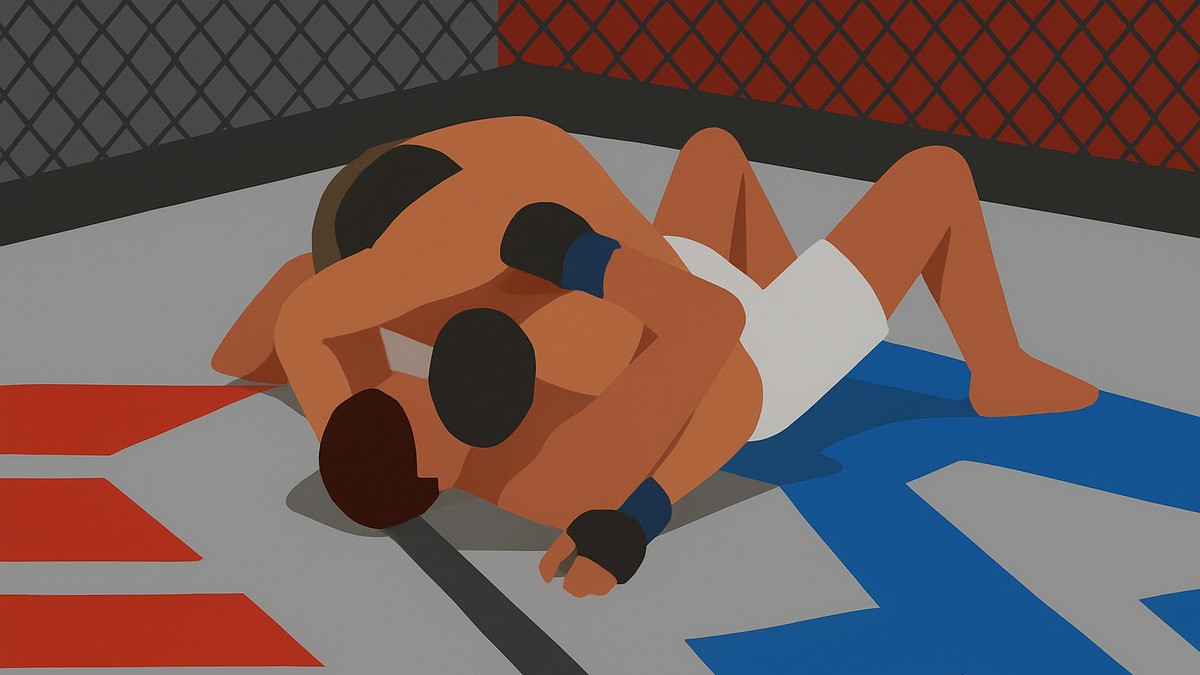
The clinch follows the same denial logic as the ground game, but the tutorial only touches the surface here. You can deny over-under and turn transitions by holding the denial input and pushing the right stick in the direction of the opponent’s movement. Certain clinch positions allow you to break free, while others lock you in and force you to deny or reverse before you can escape. The over-under clinch in particular has a specific evasion window you can drill in practice mode with time dilation turned on. A full clinch breakdown is a topic for another day, but the core skill — reading the direction and denying — carries over directly from the ground game.
Where to go next
Once you understand positional denial and grapple advantage, the natural next step is ground-and-pound offense and defense. Posture-up positions, stack guard, and striking modifiers all layer on top of the grappling hierarchy. The submission system is its own deep mechanic, especially the contextual racing animations where you can hand-fight and reverse a submission entry by denying in the choke’s direction. Reversals and contextual animations deserve focused study, as they depend heavily on fighter move levels and timing. Finally, rounding out your striking fundamentals will make you dangerous on the feet, so you can choose when to take the fight to the ground on your own terms.
Frequently Asked Questions
What is grapple advantage and how do I build it?
Grapple advantage is a meter at the top of the screen that fills up when you successfully deny your opponent’s transitions or land strikes from a grappling position. The more advantage you build, the faster your own transitions become, making them harder to defend. You can also gain advantage when your opponent pre-denies the wrong direction.
Why does pre-denying sometimes give my opponent a free transition?
If you pre-deny a direction and your opponent goes the other way, the game locks you out of that denial window entirely. The transition becomes free because you already committed your denial to the wrong side. Additionally, if you pre-deny and they don’t move at all, they passively gain grapple advantage.
How do I practice denials without a second player?
Go to practice mode and set the initial ground position or initial clinch position to the spot you want to drill. For takedown defense, set the AI takedown behavior to drive into the cage or change direction. Turn on contextual time dilation to slow the action and learn the denial windows for normal transitions, takedowns, turns, and clinch evasion.
How do I attack submissions or reverse from a bad position?
Hold L2 to see submission options from your current position. Some reversals require holding L2 + R2 and pushing a specific direction. Which submissions and reversals are available depends on your fighter’s move levels — wrestlers get different reversals than jiu-jitsu specialists. From positions like rubber guard, you can build grapple advantage, transition to full guard for free, and immediately attack a submission.
Video help



Leave a Reply