
Aliens: Fireteam Elite 2 has no published post-launch roadmap at launch, but Cold Iron Studios locked in day-one cross-play, peer-to-peer co-op with host migration, friendly fire on Intense and above, no dead-player revives at launch, and Horde-specific rewards and achievements.
Cold Iron Studios spent the weeks before release answering the community directly, running two full rounds of questions on its official Discord and giving real answers to 18 of them. With Aliens: Fireteam Elite 2 due August 25, 2026 on PlayStation 5, Xbox Series X|S, Steam and the Epic Games Store (with a Switch 2 version to follow in autumn), those answers settle a lot of last-minute questions. A couple of them also change how you should approach the harder difficulties, so here is what the studio actually said.
The major answers before launch day
| Topic | Developer answer |
|---|---|
| Post-launch roadmap | None dated or promised at launch |
| Reviving dead players | Not in the launch feature set |
| Friendly fire | On at Intense difficulty and above |
| AI teammate damage | Your AI squad can never damage you |
| Co-op networking | Peer-to-peer with host migration and session rejoin |
| Cross-play | Cross-platform play at launch across PC and consoles |
| Quick Play | Covers campaign missions, Horde, or both together |
| Horde mode | Horde-specific achievements plus perks and rewards |
| Long-term tracking | Green stamps and lifetime stats return |
| Paid packs | No unique perk-board perks; no pay-to-win |
This is a cluster of separate confirmations rather than one big reveal, spread across a July round and an August round of questions. Most of it is reassuring, but two answers stand out because they directly shape how you play: there is no way to revive a downed teammate, and friendly fire is live from Intense upward. The rest fills in how co-op, Horde and the new class actually work.
No dated roadmap, but support is planned
Key The very first August question asked about a post-launch roadmap, and the honest answer is that there isn’t one. Nothing is dated and nothing is promised. The studio says it wants to support the game well beyond launch and is actively planning what that looks like, but at release the focus is a strong experience and quick responses to player feedback.
You can see that wait-and-see stance in how they handle new classes. Asked specifically about adding a new class like the Phalanx through downloadable content later, Cold Iron said it wants to see how players engage with the existing six first, and that data decides whether more classes are the right next step. When July questions pressed on whether the first game’s rough launch would repeat, the studio called that a fair concern and committed to prioritizing high-impact issues and stability out of the gate.
Friendly fire, AI safety, and no revives
| Situation | Rule |
|---|---|
| AI teammate shooting you | No friendly damage to players, ever |
| You shooting an AI teammate | You can still damage them |
| Friendly fire activation | Turns on at Intense and above |
| Uncontrolled-targeting abilities | No friendly damage (e.g. the Machinist gas turret) |
| Sentry guns | Excluded from friendly fire |
| Marauder reload-rocket perk | Excluded from friendly fire |
| Flame, environmental fire, explosions | Friendly damage cut significantly |
| Reviving a downed teammate | No revive at launch; you spectate the rest |
Friendly fire got the most detailed answer of the whole second round, and it is more nuanced than a simple on/off switch. Your AI teammates will not deal any damage to you at all, but you can still damage them, and friendly fire between human players switches on at Intense difficulty and above.
The studio went further than most players expected on the edge cases. Abilities where you have little or no control over what they target do no friendly damage, with the Machinist gas turret as the example since you never choose what it fires at. Sentry guns are off the list too, and so is the Marauder perk that automatically fires a rocket when you reload. Flamethrowers were apparently a major source of downed squadmates, so flame damage, environmental fire and explosions all had their friendly-fire numbers cut hard. In the first game friendly fire was one broad value of around 10 percent; now the studio can dial an individual ability down to a quarter of that.
All of that matters more because of the answer that surprised players most: a dead teammate cannot be picked back up. The developers said they love the idea of a cocoon-style rescue and had early discussions on how it could work, but it did not make the launch feature set. Going down still means sitting out the rest of the mission, so higher-difficulty squads should treat every push as if there is no comeback — because there isn’t one yet.
On Intense difficulty and above, keep flame and explosive weapons off teammates and play the harder runs cautiously — friendly fire is live and there is no way to revive a downed player mid-mission.
Co-op networking, cross-play, and Quick Play
Co-op runs peer-to-peer rather than on dedicated servers, exactly like the first game. The studio hasn’t left that alone, though: host migration is in, so if the host drops the session moves to one of the clients, and session rejoin means a bad connection no longer ends the night for everyone.
Cross-platform play is set for launch day, so the whole squad can be on different systems from the start. Quick Play covers campaign missions and Horde mode from day one — you can queue for either one on its own or for both together, which makes filling a fireteam far less of a chore than it was at the original’s launch.
Horde rewards and completion tracking
In the first game the toughest thing you could chase was the campaign on Insane, yet Horde was arguably harder and gave you nothing lasting for beating it. The sequel fixes that. Cold Iron called Horde some of the toughest and most rewarding content in the original, so the sequel adds Horde-specific achievements plus perks and rewards tied to playing the mode. One caveat worth setting expectations on: those achievements will not cover every difficulty milestone across all of the Horde content.
For long-haul players, the two systems that kept people going for years are back. Green stamps and lifetime stats both return, carrying the same sense of tracking and completion forward. The studio stopped short of laying out exact Horde loot tables, drop rules or XP rates for the sequel, so treat wave-by-wave reward specifics as unsettled until you’re in the mode yourself.
Other practical answers players should know
| Feature | Status |
|---|---|
| Map generation | Crafted level design, not procedural |
| Map layouts | More vertical, open and interconnected |
| Spawns and enemy mix | Randomized per load, scaling with difficulty |
| Specialist class | Inherits abilities unlocked on the other five classes |
| Shoulder swapping | Manual while aiming; auto in cover; left-locked otherwise |
| Hub firing range | No full range; infinite-ammo crate and cover-test railing |
| Generative AI | Not used for any art, audio or models |
The remaining confirmations are smaller but shape the moment-to-moment feel. Maps are hand-crafted rather than procedurally generated, which lets the studio control pacing, tension and set-piece moments, with dynamic elements and increasingly randomized spawns layered on top so no two runs load the same. The old approach of picking a corner and holding it is gone: with four marines instead of three, spaces are more vertical, open and interconnected, and enemies were retuned to pressure angles and close distance faster, forcing you to keep moving.
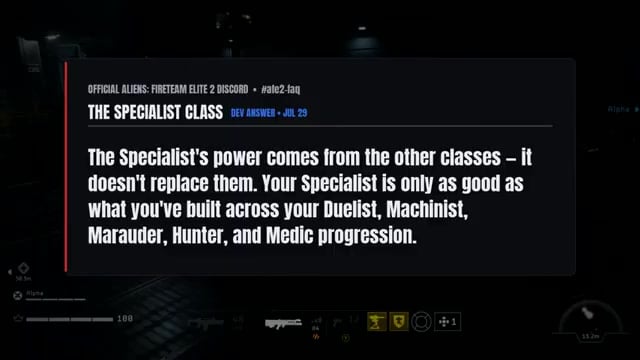
The Specialist question came up in both rounds, and the answer clears up why it doesn’t make the other classes pointless: it draws its power from them rather than replacing them. You unlock abilities on the Duelist, Machinist, Marauder, Hunter and Medic, those abilities stay with each class, and they also become available to the Specialist — so your Specialist is only ever as strong as what you’ve built across the other five. On the quality-of-life side, full free shoulder swapping was held back because of how complex the mirroring gets, and while there’s no full firing range, the hub has an infinite-ammo crate in the hangar, a railing for testing the cover system, and the ability to burn consumables without actually losing them.
Frequently Asked Questions
Does cross-play also mean cross-progression or cross-save?
Cross-play lets you squad up across PC and consoles at launch, but the studio hasn’t established cross-progression or cross-save between platforms. Until that’s stated otherwise, plan on your unlocks, cosmetics and progression staying tied to whichever platform you played them on.
Does Aliens: Fireteam Elite 2 use dedicated servers?
No. Co-op is peer-to-peer, the same setup as the first game, so session quality depends on whoever is hosting. The difference this time is that host migration hands the session to another player if the host drops, and session rejoin lets you get back in after a disconnect instead of losing the run for the whole squad.
Do paid packs add unique perks to the perk board?
No — the packs add no unique perks to your perk board. Any small perks in them unlock at weapon rank three and are also granted by other weapons. On augments, the studio’s stated rule is that one picked every single time is a design failure: Rain’s augment only works on her own weapon, while the Herk and Ripley weapon augments can be moved onto other weapons, and paid content is meant to be worth buying without ever tipping into pay-to-win.
Video help


Leave a Reply