

Pathogenic released on July 16, 2026, for PC via Steam, and it is a 2D cellular roguelike twin-stick shooter where you play as a disease evolving inside a human body.
Slug Disco’s microscopic shooter spent a long stretch as a Steam demo before finally shipping in full, and the launch build is the version that has all of it — the complete roster of pathogens, the deep organ levels, and the bosses waiting at the bottom of them. The premise is the hook: you are the infection, and the human body is the dungeon. Here’s the release picture and what the game actually does once you’re inside a host.
Pathogenic release date, developer, and storefront
| Detail | Answer |
|---|---|
| Release date | July 16, 2026 |
| Status | Out now |
| Platform | PC (Windows) |
| Storefront | Steam |
| Developer | Aberrant Labs |
| Publisher | Slug Disco |
| Genre | 2D roguelike twin-stick shooter |
Pathogenic launched as a finished 1.0 release rather than an early-access build, arriving straight out of a demo that had been running and growing for months. Steam files it under Action, Indie, RPG, and Simulation, which is a fair description of a game that plays like a shooter but keeps stopping to hand you loadout decisions.
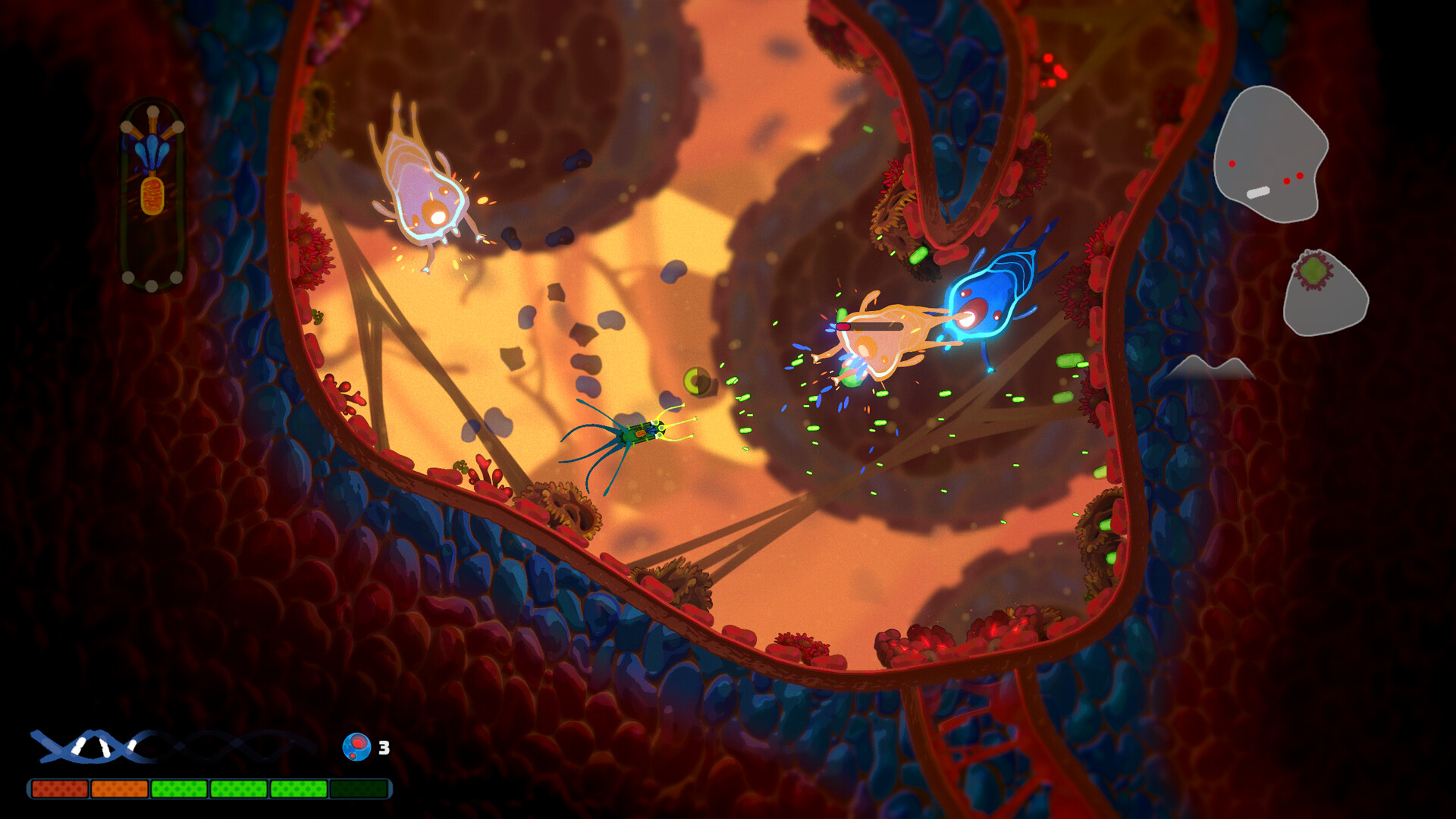
What you actually play as in Pathogenic
You are the disease. A single lone parasite gets dropped into a human host, and every defense that body has for keeping itself alive is the thing hunting you. The goal is blunt — infect and conquer the host — and the route there is a microscopic arms race where the immune system escalates as fast as you do.
Mechanically it’s a twin-stick shooter first. You steer a wobbling blob of a creature through cramped biological spaces and fire in whatever direction you’re pointing, while macrophages, T cells, and worse crowd in from every side. The roguelike structure wraps around that: runs, not campaigns, with adaptation on the fly instead of a save file that slowly gets stronger.
The RPG and simulation tags earn their place in between the fights, because so much of Pathogenic is deciding what your parasite is. You don’t pick a class and stick with it — you assemble one out of whatever the host coughs up along the way.
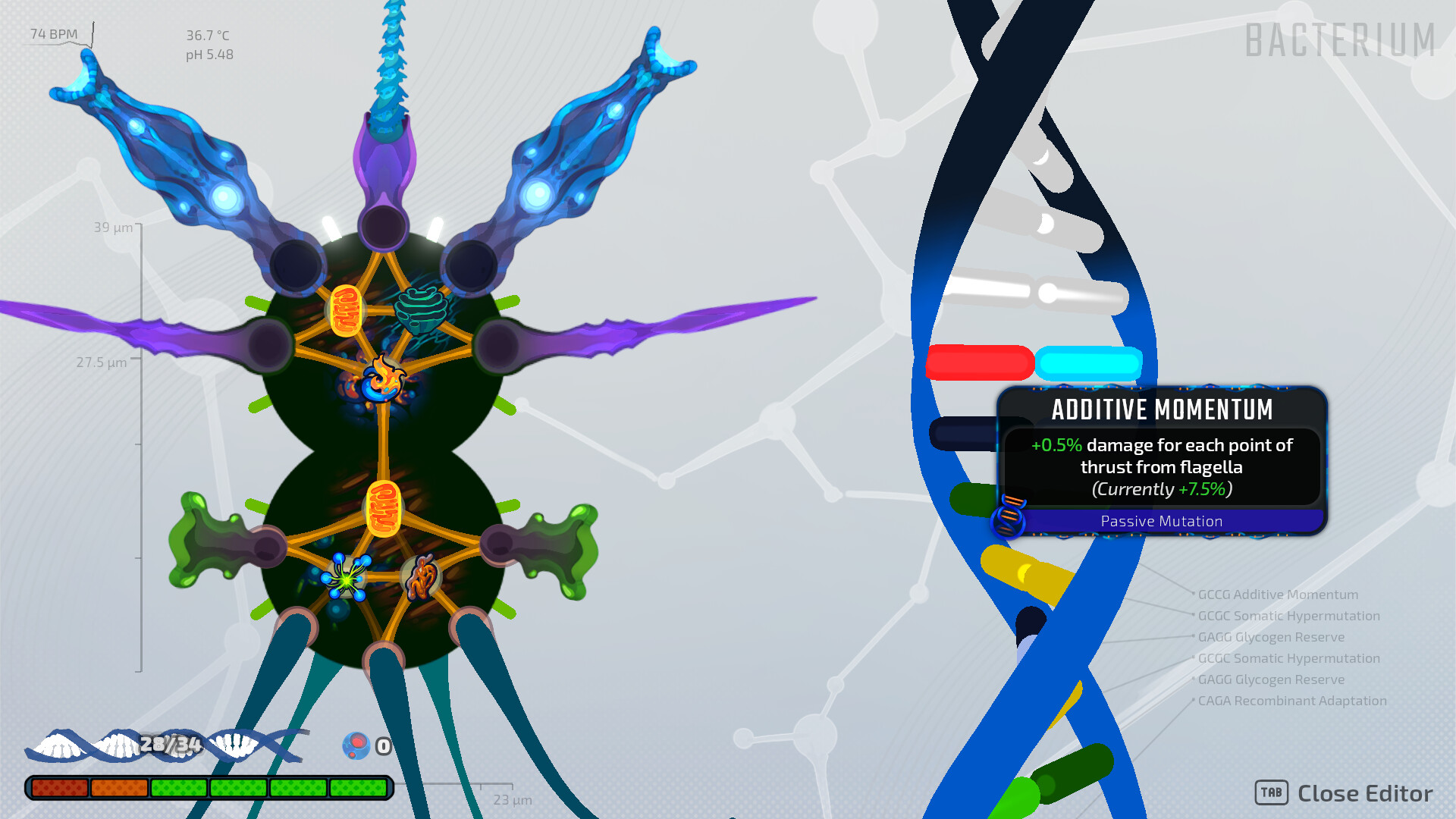
How runs and organelle builds work
| System | What it does |
|---|---|
| Pathogens | Seven playable bodies, each with its own layout rules and starting kit. |
| Organelles | Over 120 looted parts and mutations you graft onto the pathogen. |
| Organ levels | Six organs of the human body plus a secret level, generated fresh each run. |
| Immune enemies | Macrophages, T cells, and rival parasites defending the host. |
| Bosses | Multi-phase fights lurking deep inside each organ. |
| Challenge modes | Optional rulesets that set unique conditions on a run. |
A run drops you into a procedurally generated stretch of the human interior and asks you to fight your way down through it. Rooms are packed with immune cells and rival parasites — tapeworms and protozoa among them — and clearing them is what pays out the parts you need for the next floor.
Those parts are organelles, and grafting them onto your pathogen is the whole game. Flagella handle movement, mitochondria supply power, secretors give you ranged attacks, and spikes cover melee, with internal organelles layering on passive buffs and pseudopods auto-attacking whatever wanders closest. The specific ones get genuinely strange: the chromatophore lens charges off your mitochondria and releases a laser, the trophic pseudopod reaches for the nearest enemy while overcharging your other organelles, and the ballistic flagellum fires bullets backwards every time you sprint or dash away, which is a kite build waiting to happen.
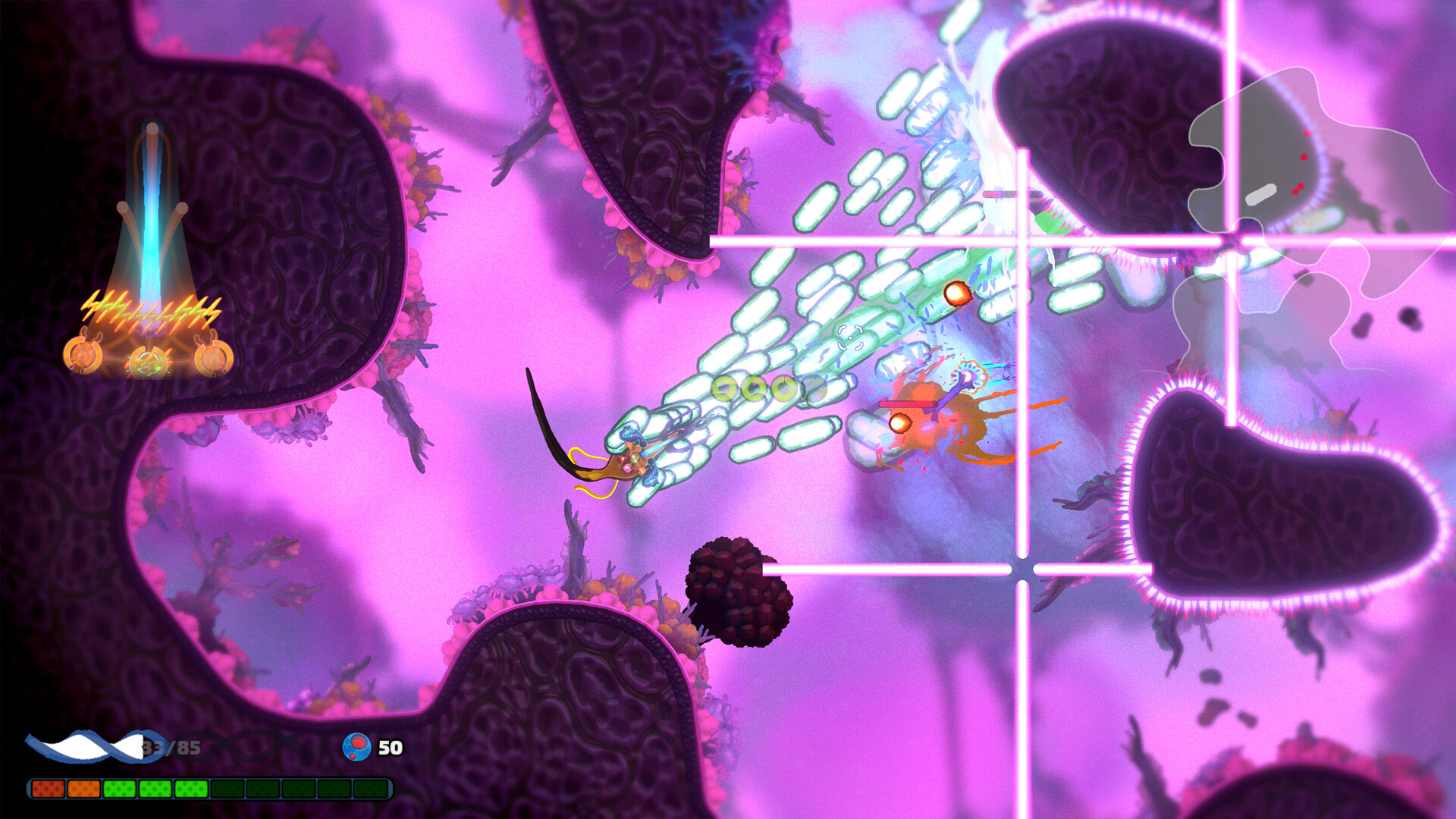
What launched with the full 1.0 build
The organ levels are where the launch content lands hardest. The Lungs fill the screen with air sacs and blow holes that shove your movement around and occasionally detonate, then cap the run with new bosses that have a second phase. The Heart goes further — the blood flow is strong enough that your pathogen simply drifts along the veins, unable to turn back or fast travel via the map, so every reward you can see down a branching path is a one-way commitment before the final boss. The Intestines bring their own winding-maze problem, and the secret level is still out there for anyone who digs.
Launch also added organelle traits, a mechanic that attaches special keywords to organelles you find in the wild: a real stat boost with a condition welded to it, and a few challenge modes built entirely around them. The existing challenge set is already a good measure of how far the game will bend — Phagocytosis is melee only, Metamorphosis rerolls your organelles every single room, Hyperplasia hands you far more rooms but closes the level in on you within three minutes, and Photosynthesis strips out weapon organelles entirely and leaves you defending yourself with actives, pseudopods, and flagella.
Holding all of it together is a soft-body physics simulation, which is why every cell, enemy, and projectile wobbles and squashes with a weight that a normal sprite-based shooter never has. It’s the thing that makes a game about grafting spikes onto a blob feel organic instead of clinical.
Where Pathogenic is playable
The Steam page is also the game’s post-launch home base — patch notes, guides, screenshots, and community discussion all run through its hub rather than a separate site.
Frequently Asked Questions
In Pathogenic out now?
What platforms is Pathogenic on?
In Pathogenic coming to PS5, Xbox, Switch, or Game Pass?
Who developed and published Pathogenic?
What kind of game is Pathogenic?
More questions⤵
Does Pathogenic have co-op?
Video help






Leave a Reply