
Do not rush Legendary gear in Mistfall Hunter: the efficient path is to build around targeted affix breakpoints, use the right Victory Wine for your tier, and stop around strong blue or purple setups unless you can afford major losses.
Mistfall Hunter gearing gets expensive fast because color, affix levels, sockets, wines, rerolls, and binding rules all stack into one decision. The smart route is to buy power only when the next setup gives you a real level 4 or level 5 breakpoint, not just a prettier item border.
Target affixes before rarity
The core rule is simple: value beats rarity. A focused green or blue setup with the right affix breakpoints can outperform a rushed higher-color build with scattered rolls.
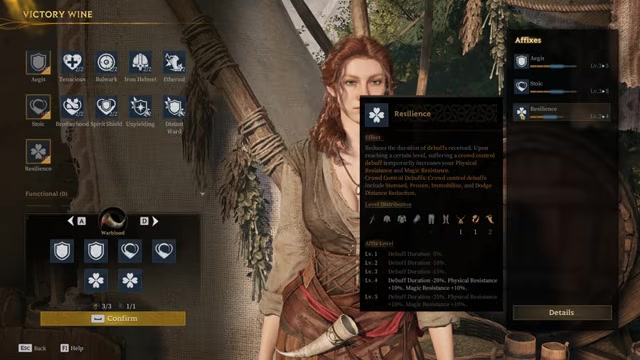
Save the big spending until you know which affix line your class and weapon actually use. Legendary and Holy chasing should come after you understand loss risk, auction binding, and whether the upgrade changes your build instead of only adding small stats.
Only spend when the upgrade unlocks a real affix breakpoint; if the next color only adds a small stat line, keep the gold for rerolls, gems, and the Victory Wine for your next run.
Gear systems that set your spend
| System | Use |
|---|---|
| Combat bags | Free prebuilt loadouts that also matter for difficulty access. |
| Item quality | Main spend track: green, Excellent blue, Epic purple, Legendary orange, then Holy above standard loot. |
| Affix levels | Perk ranks that become worth paying for when they hit level 4 or level 5 breakpoints. |
| Sockets and gems | Support the same build line; a missing high-tier gem can shift build value by roughly 300. |
| Victory Wine and tonics | One-run buffs used before a mission to push temporary affix thresholds. |
| Gilden Blood rerolls | Reroll combat bag loadouts; purple-tier bag rerolls can cost up to 100 Gilden Blood. |
| Difficulty gates | Missions check both combat bag tier and equipped item quality. |
| Item binding | Purple auction-house purchases bind to your character after purchase, but not immediately after purchase. |
The one label wrinkle is combat bags. Current bag mapping puts Novice at white, Advanced at green, Pro at blue, and Elite at purple, while some early green progression examples describe the first green spike as a Novice bag. For spending decisions, read the item color and affix ranks on the loadout.
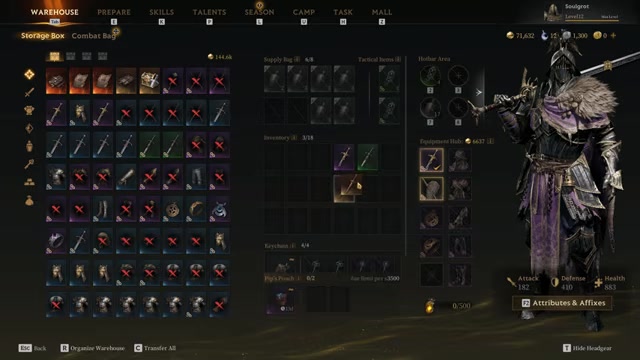
Victory Wine and tonics are run tools, not permanent upgrades. Drink them at Camp when they push a near-threshold build over a useful breakpoint for the queue you are actually taking.
Green to purple value path
| Stage | Best value setup | Avoid |
|---|---|---|
| First green spike | Green weapon and chest with the cheap tonic route to reach an early level 5 passive. | Overspending before choosing the affix your build is built around. |
| Green sweet spot | Full green with War Blood to hit a level 4 breakpoint such as Resilience; the stronger route costs about 250 more than the cheapest green setup. | Hero’s Ale, and treating a blue weapon as mandatory. |
| Blue core | Blue gear with War Blood for four level 5 passives and a small lower passive. | Using low-tier wine habits after the build value jumps near the 3,400 range. |
| Blue push | Blue gear plus a purple weapon if you can handle the added loss risk. | Buying purple armor before taking the better-value weapon jump. |
| Purple core | Purple gear with War Blood or God’s Brew once the build value jumps from roughly 3,300 to 6,600. | Queuing expensive kits as if every death is affordable. |
| Purple min-max | God’s Brew for extra breakpoint flexibility, including Vitality, Burst, Seeker, Valor, or Strafe layouts. | Adding Legendary weapon value before the affix gain is worth the loss risk. |
Green is where you learn the shape of your build. The clean target is a full green setup that reaches one meaningful breakpoint, then stops unless a blue weapon clearly changes your passive layout.
Blue is the best middle tier for most players because War Blood already pushes strong passive counts, while God’s Brew lets you turn a lower passive into a stronger level 4 line. Purple is where spending doubles, so every point should have a purpose before you queue.
Affix breakpoints worth building around
| Affix | Best use |
|---|---|
| Resilience | Level 4 gives 10% physical and magic resist for PvP and general durability. |
| Burst | Wither Knight burst windows; level 4 boosts Wither Execution damage by 20%. |
| Smiting | Energy recovery setups; the level 4 breakthrough cuts cooldown by 1 second. |
| Bulwark | Shield builds, with 24% block damage reduction and +9 block energy cost reduction. |
| Elusive | Dodge-heavy PvP; level 2 is cheap value, while level 3 and level 4 scale to 12% and 16% dodge energy cost reduction. |
| Vitality | Extra energy pool, adding 20 energy on a 100-energy baseline. |
| Valor | Spare points for attack, or damage-stacked purple layouts. |
| Strafe | Damage-focused purple setups beside Valor and Elusive. |
| Seeker | Movement-speed breakpoint when your build needs mobility more than another defensive line. |
Do not treat these as a universal ranking. Pick the affix that fits your weapon, class, and role, then use gear, gems, and wine to reach the breakpoint that changes how the build fights.
At purple, several layouts are viable: five level 5 passives with a level 4 line, four level 5 passives with two level 4 lines, or a damage-heavy spread such as high Valor, Strafe, Elusive, and Resilience. The right answer is the one that turns your actual fights, not the one with the rarest color.
Weapon color upgrades by value
| Upgrade | Verdict |
|---|---|
| Green gear plus blue weapon | Optional. It raises build value by about 25%, adds 6 attack and 2% physical damage, and can move the setup into three level 5 passives. |
| Blue gear plus purple weapon | Strong value. The build value rises roughly from 3,339 to 3,800, while the extra access can enable five level 5 passives. |
| Purple gear plus Legendary weapon | Poor value for most players. The build can rise near 8,500 with gem cost, while the weapon adds only 5 attack, 1.2% physical damage, and a lower-impact extra affix. |
Weapons are the one place where jumping a color can make sense before replacing the whole kit. The deciding question is whether the weapon opens another major passive breakpoint.
The blue-to-purple weapon jump is the cleanest offensive upgrade because it can change your passive count without doubling your full kit cost. The purple-to-Legendary jump is mostly a wealth check.
Purple auction purchases do not bind immediately
Be slow with purple auction-house buying. Purple items bought from the auction house still bind to that character, but they do not bind immediately after purchase, so confirm the bind timing before treating the item like normal resale stock.
Plan the full build before buying the first piece. Check the weapon, armor, sockets, passive targets, and wine breakpoint together, because one mismatch can leave you either running an unoptimized kit or selling the item to a vendor for a fraction of its auction value.
This matters most when you are copying a purple setup from memory. Purple is expensive enough that “close enough” can become the costliest part of the build.
Legendary and Holy timing after August 6
Legendary gear is for players who can absorb major losses. A purple sword can sit around 470 while a Legendary sword can reach about 2,300, and good Legendary armor can cost more than five times the purple equivalent without giving five times the combat value.
Cataclysm does not require a Legendary kit when your purple setup is coherent. Legendary can make runs easier, but it is not the efficient place to park your gold if you are still queuing with random teammates or learning boss patterns.
Holy gear is a separate endgame track. The August 6 Live Update added Dried Flower Knot drops from challenging Mist Lords in Einherjar Mode, feeding Holy Weapon and Holy Forging Material progression. Holy Weapons matter because their exclusive gameplay affixes can reshape skills instead of only raising numbers.
KEY!
If a Holy weapon drops, do not dump it cheaply. Holy gear is tied to low-chance late-game acquisition, and the current market cap of 15,000 Gilden Blood can undervalue it; hold it in storage until you are ready to use it or the market ceiling changes.
Related Mistfall Hunter guides
Frequently Asked Questions
Can blue gear clear Chaos difficulty in Mistfall Hunter?
Yes. A well-built blue setup can clear Chaos bosses, and green gear can do it too with a much harder run. The stronger blue plan is to stack enough level 5 passives first, then add a purple weapon only when the extra loss risk feels acceptable.
Can purple gear clear Cataclysm in Mistfall Hunter?
Yes. Purple gear is enough for Cataclysm when the build is coherent, which is why Legendary should be treated as comfort, speed, or high-risk min-maxing rather than the entry ticket.
Should you sell Holy gear if you get one in Mistfall Hunter?
No. Hold Holy gear in storage unless you are ready to use it, because the current 15,000 Gilden Blood market cap can sit below its real value.
Video help




Leave a Reply