
To increase damage in Evomon, stack the right offensive stat, talent, nature, trait, evolution, equipment upgrades, type advantage, weather effects, and battle-specific damage buffs instead of relying only on levels.
Damage in Evomon is not just a level check. Two players can use the same Evon and get very different results because one build is stacking the correct systems while the other is only grinding XP.
The strongest damage builds line up the Evon’s main attack stat, move category, talent, nature, trait, evolution path, equipment, and battle matchup toward the same job: making one reliable damage dealer hit as hard as possible.
- Damage sources to stack in Evomon
- Match each move to Attack or Special Attack
- Pick a talent and nature for your damage stat
- Use traits that improve damage timing
- Grow damage through levels, evolution, ascension, and moves
- Upgrade equipment after level 40
- Exploit type matchups, weather, and team roles
- Time temporary damage effects in hard fights
- Fix common damage mistakes
- Frequently Asked Questions
Damage sources to stack in Evomon
| Damage lever | What |
|---|---|
| Move stat matching | Use moves that scale with your Evon’s stronger Attack or Special Attack. |
| Talent | Look for talent rolls that boost the offensive stat your main attacks use. |
| Nature | Use a nature that raises the right damage stat by 10% and does not cut it by 10%. |
| Traits | At level 30, reroll toward a passive that improves damage, timing, or battle value. |
| Level | Raise levels for better base stats and access to stronger learned moves. |
| Stronger moves | Replace weak skills when your Evon learns better offensive options. |
| Evolution | Evolve as soon as you meet the level and material requirements for the next form. |
| Ascension | Use ascension to push level-cap growth and long-term stat scaling higher. |
| Equipment | Equip gear that adds useful offensive stats once equipment challenges unlock. |
| Refine and enhance | Improve gear stat quality with refining, then raise bonuses further with enhancing. |
| Type matchups | Attack into weaknesses instead of forcing neutral or resisted hits. |
| Weather effects | Use weather that strengthens your strategy or works with your traits. |
| Temporary damage effects | Use switch-in hits, rebound effects, and sequencing bonuses when a fight supports them. |
| Team role choice | Build around at least one dedicated damage dealer instead of a full mixed team. |
KEY!Think of these as layers. A level boost helps, but a level boost on the wrong move type, wrong nature, bad talent roll, and poor matchup will still feel weak. Damage climbs fastest when each system supports the same offensive plan.

Match each move to Attack or Special Attack
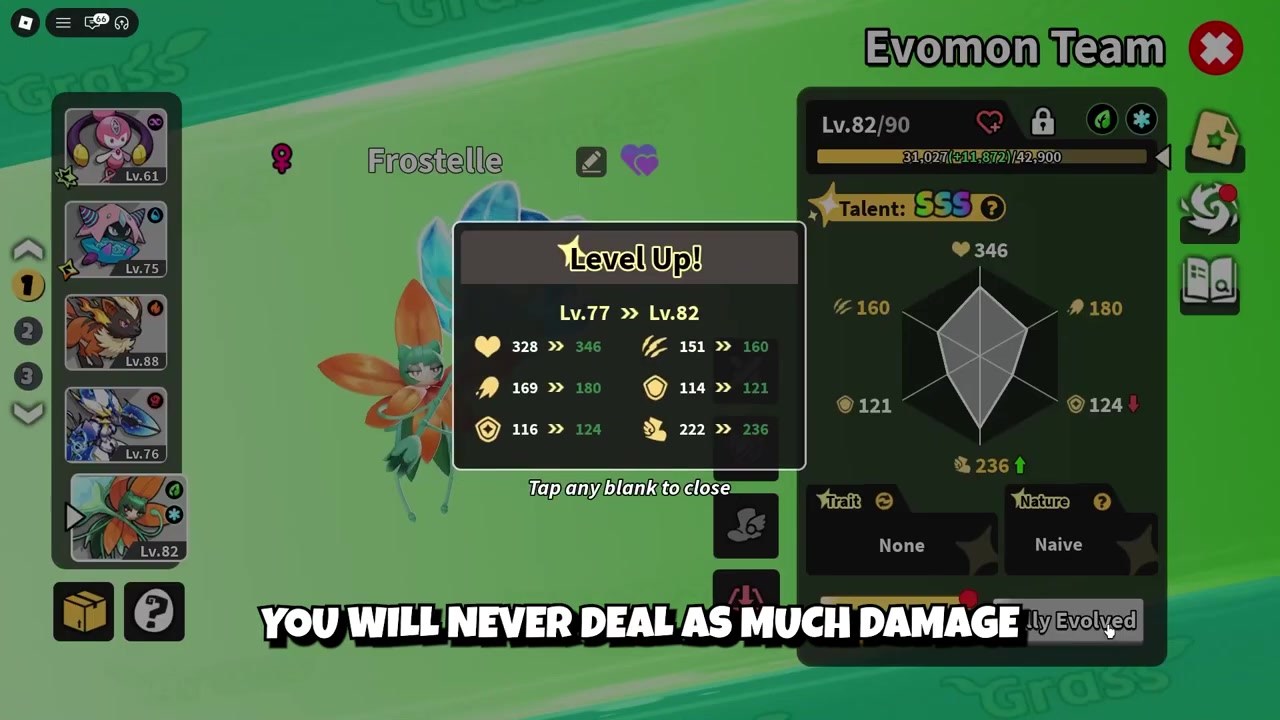
The foundation of every damage build is simple: your Evon’s damaging moves must match the offensive stat you are building. Some skills scale with Attack or Physical Attack, while others scale with Special Attack. If your Evon has high Physical Attack but you keep using Special moves, the build will underperform even if the Evon is high level.
This is also why talents and nature can feel stronger than they look. A talent that boosts three stats is only useful for damage if one of those stats is the same offensive stat your best attacks use. A nature that raises the wrong attack stat can leave your main skills hitting far below their potential.
Before spending reroll items or upgrade materials, check the Evon’s main damaging skills first. If your best move is Physical, build around Attack. If your best move is Special, build around Special Attack. Mixed setups can work, but they are harder to optimize because your talent, nature, and gear bonuses get split instead of concentrated.
This is the mistake that makes many “same Evon, lower damage” situations happen. The monster may be correct, but the stat support is aimed at the wrong side of its kit.
Pick a talent and nature for your damage stat
| System | Best damage use |
|---|---|
| Move stat matching | Choose main attacks that use your Evon’s stronger Attack or Special Attack. |
| Talent | Prioritize rolls that boost the offensive stat your best skills scale from. |
| Talent rank | Higher ranks provide larger bonuses, but only the right boosted stats help damage. |
| Talent Vector Potions | Use them when a key Evon has talent boosts that do not fit its damage role. |
| Nature | Take the +10% on your damage stat and avoid a -10% cut to that same stat. |
| Nature roll potion | Reroll when the nature pushes your Evon away from its strongest offensive stat. |
Every Evon is caught with a random talent that increases three different stats. Higher talent ranks give larger bonuses, but the boosted stats matter just as much as the rank. For a main damage dealer, an attack-focused talent roll is far more valuable than a defensive-looking roll that does not improve the skills you actually press.
Talent rerolling is worth considering when the current boosts miss your Evon’s damage stat. Talent Vector Potions can be used for talent rerolls, so save that kind of rerolling for Evomons you are actually building around instead of spending it on every temporary party member.
Nature is the cleaner damage lever. Each nature increases one stat by 10% while decreasing another by 10%. That swing is large enough to matter, especially when it boosts the same offensive stat your talent and moves already favor.
Do not reroll just because a nature or talent is not perfect on paper. Reroll when it actively works against the Evon’s role: Special Attack boosts on a Physical attacker, Attack boosts on a Special attacker, or defensive boosts on the monster you expect to carry damage.
Check your main move category before rerolling anything: if your best attack uses Special Attack, every serious damage upgrade should support Special Attack first.
Use traits that improve damage timing
Traits unlock once an Evon reaches level 30. They are passive effects, and some of them directly improve damage while others create better timing windows or make a damage dealer more reliable in specific fights.
Because traits can be rerolled, your main Evon should not be left with a passive that only helps a role it is not playing. A damage dealer wants a trait that either raises damage, helps it land a stronger turn, or supports a battle plan where it gets maximum value from its best move.
One advanced example is the Arcaphex or Arcapex first-attack style effect, where a switch-in hit can deal much higher damage. The dossier uses both Arcaphex and Arcapex spellings, so check the in-game name before publishing a build around it, but the damage idea is clear: some traits reward careful timing instead of raw stat stacking.
Grow damage through levels, evolution, ascension, and moves
Levels still matter. Higher-level Evomons gain more stats, and those stats feed into your damage output over time. Leveling also gives access to stronger learned moves, which can be just as important as the stat increase itself if the new move has better power or better scaling for your build.
Evolution is one of the biggest long-term damage jumps because it raises the Evon’s stats and opens the door to stronger moves. If your main damage dealer is sitting below its next evolution, you are holding back both base power and future skill options. Push the required level, then gather the needed evolution stones and element stones so the upgrade is ready when the Evon is.
Ascension matters for the same reason: it raises growth potential by pushing level caps higher. More cap room means more stat growth, which gives your optimized talent, nature, gear, and move choices a better base to multiply from.
Island progression, bosses, Summon Ruins, and World Boss all fit into this as farming contexts. Use them to keep your main damage dealer moving toward the next level, material requirement, evolution, or ascension instead of spreading progress across too many Evomons that will not be part of your core team.
Upgrade equipment after level 40
| Upgrade | Effect |
|---|---|
| Equipment | Adds stat bonuses to your Evon after equipment challenges unlock at player level 40. |
| Refine | Improves the quality of the equipment’s stat bonuses. |
| Enhance | Raises those bonuses further for more total power. |
Equipment challenges unlock at player level 40. Once that system opens, gear becomes another major way to increase damage because equipment adds stats directly to your monsters.
Do not stop at equipping the first item that looks useful. Gear can be improved through refining and enhancing, and both matter if the item is going onto your main damage dealer. The smart play is to upgrade gear that supports the Evon’s real damage stat, not random pieces just because they are available.
There is no need to guess exact costs, rates, or stat values before upgrading. The important rule is to treat gear like talents and nature: upgrade the pieces that help your damage dealer’s actual offensive stat first.
Exploit type matchups, weather, and team roles
| Element | Strong against |
|---|---|
| Fire | Grass, Bug, Steel, Ice |
| Water | Fire, Rock, Ground |
| Grass | Water, Rock, Ground |
Type advantage can beat small stat upgrades because it changes the real damage that lands in battle. A neutral-looking hit can become much stronger when it targets a weakness, while a high-level Evon can still feel bad if it keeps using resisted or poorly matched attacks.
Use those matchups as a model for how to think in fights: the correct element often deals more effective damage than simply sending out your highest-level Evon. If a battle preview shows a much better hit from a different element, take the matchup instead of forcing your usual attacker into a bad target.
Weather adds another layer. Certain weather conditions strengthen specific strategies, and some traits can change the weather when an Evon enters battle. That makes weather especially useful when your team is already built around one element, trait interaction, or repeated damage pattern.
Team setup matters too. Run at least one reliable damage dealer whose job is to hit hard, then use the rest of the team for coverage, survival, or setup. A party full of mixed or defensive Evomons may survive longer, but it can struggle in fights where you need one strong turn before the enemy responds.
Time temporary damage effects in hard fights
Some damage gains are not permanent stat upgrades. They come from timing: switching in at the right moment, using a battle-specific passive, sequencing moves, or taking advantage of an enemy action.
The switch-in first-hit effect tied to Arcaphex or Arcapex is the clearest example. When a trait makes the first attack after switching in hit harder, the value comes from saving that Evon for the right target instead of leaving it on the field at the wrong time.
Fatal Rebound is another advanced damage trick for boss-style fights. It can hit with 1.75x attack, but the exact trigger condition after the initial setup text is cut off in the retrieved material, so treat it as a fight-specific technique rather than a universal damage button.
There is also an Electric sequencing effect described as gaining +20 power for every Electric skill used earlier in battle. The exact skill name is not visible in the retrieved snippet, but the lesson is useful: some builds scale because of move order, not just stats. In boss damage, that kind of sequencing can matter as much as raw Attack or Special Attack.
Fix common damage mistakes
| Mistake | Fix |
|---|---|
| Building the wrong offensive stat | Check whether your main moves use Attack or Special Attack, then build that stat. |
| Ignoring type advantage | Use elements that hit weaknesses instead of spamming neutral or resisted moves. |
| Using defensive talents on a main damage dealer | Reroll toward offensive talent boosts when the Evon is meant to carry damage. |
| Keeping a bad nature | Use nature rerolls when the current nature lowers or ignores your damage stat. |
| Delaying evolution | Farm the required level, evolution stones, and element stones so the stat jump is not delayed. |
| Skipping ascension | Ascend key Evomons to raise level-cap growth and long-term damage potential. |
| Upgrading random gear | Refine and enhance equipment that supports your damage dealer’s actual attack stat. |
| Copying meta teams blindly | Understand why the team works: move scaling, trait timing, matchup coverage, and battle role. |
| Using special tricks everywhere | Save effects like Fatal Rebound, switch-in hits, and sequencing bonuses for fights that support them. |
Most weak damage builds fail for the same reasons. The Evon might be good, but its stats, skills, upgrades, and battle plan are pulling in different directions.
The fix is usually not one massive upgrade. It is lining up several smaller systems so they all point at the same damage stat and the same battle role.
Frequently Asked Questions
What is the fastest way to increase damage in Evomon?
The fastest improvement is to match your best damaging move with the correct offensive stat, then use a talent and nature that boost that same stat. After that, use type advantage and evolve your main Evon as soon as the level and material requirements are ready.
Should I build Attack or Special Attack?
Build the stat your main attacks use. If your strongest move scales with Attack or Physical Attack, build Attack. If it scales with Special Attack, build Special Attack. Do not choose based only on rarity or level.
Do talents and nature matter more than level?
Levels matter because they raise stats and unlock stronger moves, but talents and nature can make the same level feel much stronger. A +10% nature on the right damage stat and a useful talent roll can outperform extra grinding when your previous setup was boosting the wrong stat.
When do traits unlock in Evomon?
Traits unlock at level 30. Once they are available, reroll toward a passive that fits the Evon’s role, especially if it is your main damage dealer.
When does equipment unlock in Evomon?
Equipment challenges unlock at player level 40. From there, equipment can add stats, refining can improve stat quality, and enhancing can raise the bonuses further.
More questions⤵
Are type matchups better than just using the highest-level Evon?
Often, yes. A correctly matched element can deal much more effective damage than a higher-level Evon using a neutral or resisted attack. Fire into Grass, Bug, Steel, or Ice is one example; Water into Fire, Rock, or Ground is another.
Does Evomon have a public damage formula?
Evomon shows useful battle damage information and visible matchup behavior, but the exact internal formula beyond visible multipliers and known effects is not publicly laid out in the supplied research. Build around the systems you can control: move stat, talent, nature, trait, evolution, gear, matchup, weather, and battle timing.
Video help




Leave a Reply