

If you’re tackling today’s Parseword puzzle and finding it tricky, you’re not alone. Parseword is a relatively new daily word game that challenges players to decode clever clues using logic, vocabulary, and wordplay. Unlike traditional crossword puzzles, Parseword focuses on understanding how words can transform into other words through creative linguistic tricks.
In this guide, you’ll find Parseword hints for August 18, 2026, followed by the full answer if you need help finishing today’s puzzle. If you’re new to the game, we’ll also explain how Parseword works and share some helpful tips that can improve your solving skills.
Parseword Hints for August 18, 2026
If you want to solve today’s puzzle on your own but need a little help, try using the hints below before checking the answer.
Hint #1
Focus on the action described at the beginning of the clue rather than treating the entire sentence as a normal phrase.
Hint #2
The clue is connected to music and performing a song rather than simply listening to one.
Hint #3
Think about what someone would do during karaoke when they take the microphone.
Hint #4
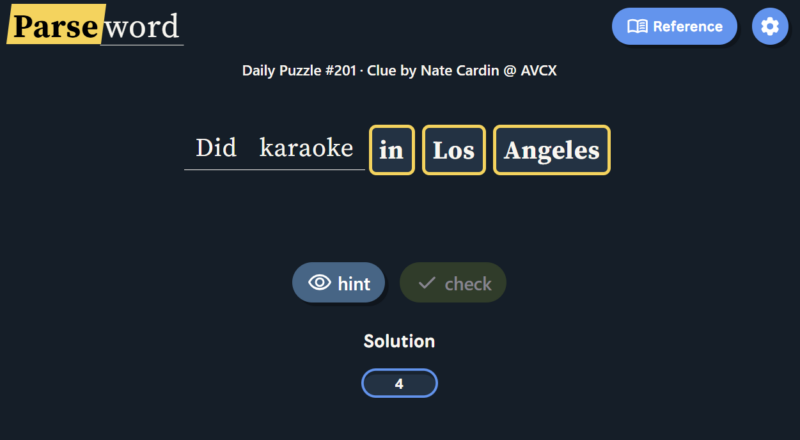
Look closely at the phrase referring to the location. The words “Los Angeles” are important to the wordplay.
Hint #5
The location phrase can be transformed into a short past-tense verb describing what someone did while performing karaoke.
Parseword Answer for August 18, 2026
⚠️ Spoiler Warning: The solution to today’s puzzle is below. ⚠️
Click here to reveal today’s Parseword answer
SANG
Step-by-Step Explanation
The key to the puzzle is separating the definition from the wordplay. The phrase “Did karaoke” describes an action, while “in Los Angeles” provides the wordplay that leads to the answer.
in Los Angeles
The location phrase is the part that needs to be parsed and transformed.
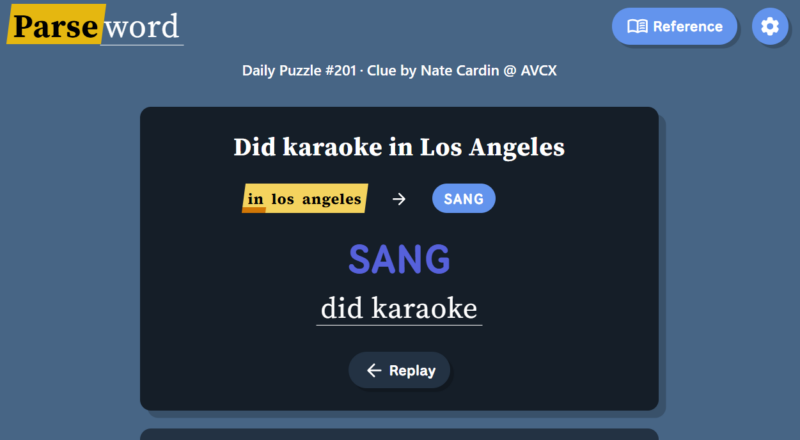
in Los Angeles → SANG
The Parseword solution shown for the puzzle converts the location phrase into SANG.
SANG → did karaoke
To sing is exactly the action performed during karaoke, and sang is the past tense. Therefore, “Did karaoke” provides the natural definition for the resulting word.
in Los Angeles → SANG
Did karaoke → SANG
The transformation produces a word that fits the clue perfectly, giving the final answer SANG.
What Is Parseword?
Parseword is a daily word puzzle created by Wordle creator Josh Wardle. The puzzle takes inspiration from cryptic crosswords, a style of puzzle known for combining definitions with clever wordplay.
Instead of guessing a word from a grid or filling crossword clues, Parseword gives players a single clue and asks them to interpret the meaning behind it. The clue usually contains both a definition of the answer and instructions for constructing the answer through word transformations.
The goal is to “parse” the clue — meaning to break it down into smaller parts that reveal how the answer is formed. Once you understand how the clue works, the final word or phrase becomes clear.
Parseword was designed to introduce players to cryptic-style puzzles in a more accessible way. Many traditional cryptic crosswords can feel intimidating for beginners, but Parseword teaches players how these clues function step by step through daily practice.
How Parseword Works
The key idea behind Parseword is that the clue hides instructions that help build the answer. Solving the puzzle usually involves recognizing different types of wordplay.
One common technique is synonym replacement. A word in the clue might be replaced with another word that has a similar meaning. For example, “large” could become “big,” or “speak” might become “say.”
Another technique involves combining words or word parts. Two separate ideas from the clue may come together to create the final answer.
You may also encounter clues that require rearranging letters, removing letters, or interpreting words in a more figurative way. These indicators are often hidden inside the clue itself, which is why careful reading is important.
Most cryptic-style clues contain two main components:
• A definition that describes the final answer
• A wordplay section that explains how to construct the answer
Learning to identify these parts is one of the most useful skills for solving Parseword puzzles.
Tips for Solving Parseword Puzzles
If you plan to play Parseword regularly, these strategies can make the puzzles easier to solve:
- Identify the definition first – The definition is usually at the beginning or end of the clue and describes the final answer.
- Look for synonyms – Many puzzles rely on replacing words with similar meanings before forming the solution.
- Watch for indicator words – Words like “mixed,” “broken,” or “inside” often hint at rearranging or modifying letters.
- Break the clue into parts – Solving smaller pieces of the clue separately can make the overall puzzle easier to understand.
- Think about word combinations – Some answers are formed by combining two or more transformed words.
- Practice daily – The more Parseword puzzles you solve, the better you’ll become at recognizing common clue patterns.
Final Thoughts
The Parseword puzzle for August 18, 2026 provides another clever example of how cryptic-style clues use wordplay and logic to lead players to the final answer. While it may seem challenging at first, each puzzle helps you build the skills needed to recognize patterns, synonyms, and clue structures.
Whether you solved the puzzle using the hints or jumped straight to the answer, Parseword is a fun daily challenge that rewards careful thinking and creativity. Be sure to check back for Parseword hints and solutions for August 19, 2026, when a brand-new puzzle arrives.
Leave a Reply