What to know
- Anthropic released Claude Opus 4.6 on Feb 5, 2026, marking its most advanced AI model yet.
- The model shows notable gains in reasoning, autonomous workflows, coding, and long-context tasks.
- Early tests show it can find novel cybersecurity issues and helps in deep engineering use cases.
- The launch has influenced broader market attention and competitive moves in the AI space.
Anthropic has unveiled Claude Opus 4.6, the newest version of its flagship AI model family, designed to push deeper into complex, multi-step tasks that go beyond simple text generation.
You can think of this release as a major step forward in agent-style artificial intelligence — where the AI doesn’t just respond to prompts but actively plans, reasons, and executes sequences of work on your behalf. That’s an evolution from earlier versions of Claude that already had strong performance in coding and workflow tasks.
One of the most eye-catching technical upgrades is support for a 1 million-token context window (in beta) — meaning the model can hold, understand, and work with vastly larger amounts of information than many other systems. That helps it maintain continuity, relevance, and coherence over longer conversations or documents.
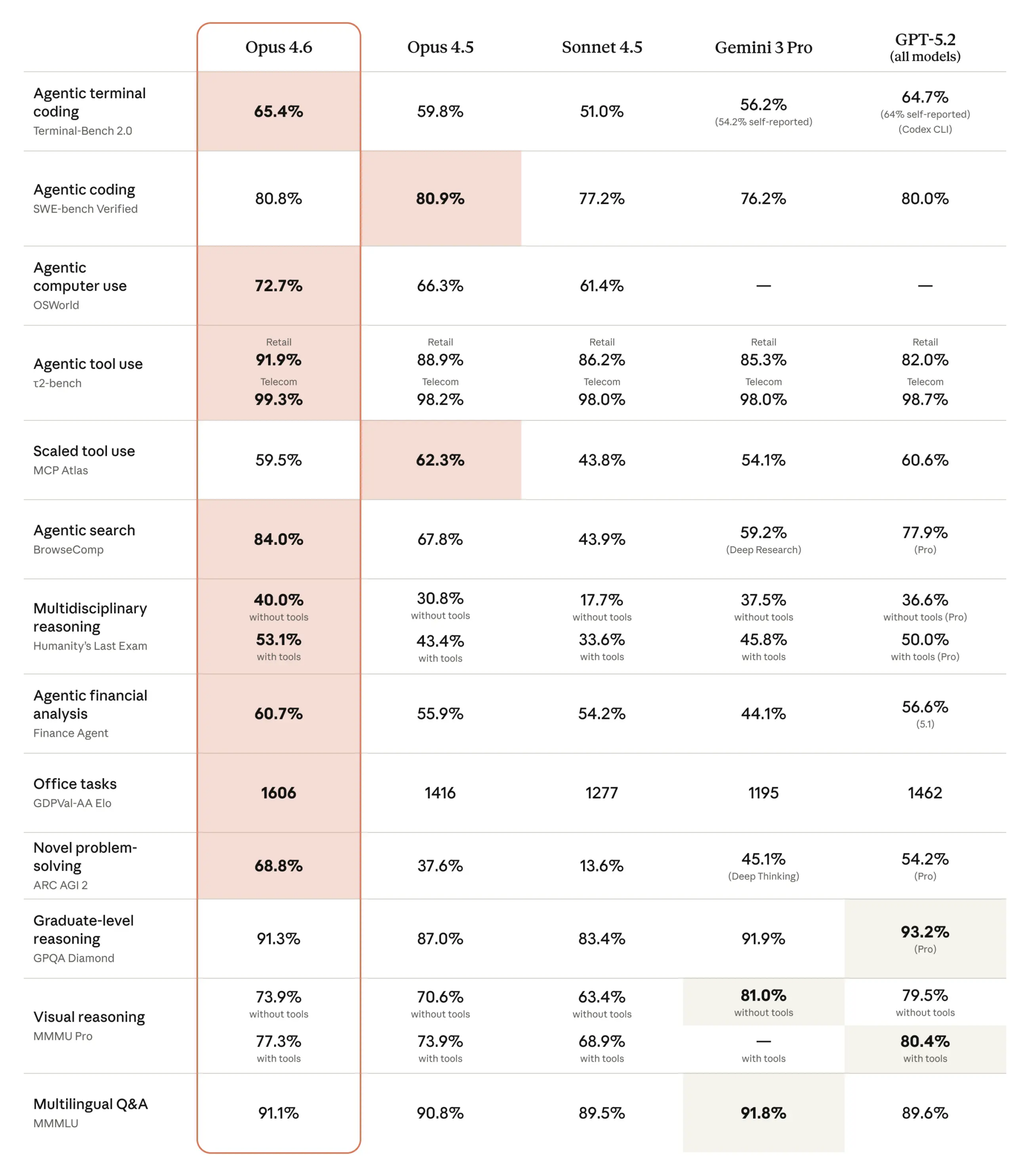
In early tests, developers reported that Claude Opus 4.6 handles planning and execution across complex workstreams, from planning code changes to debugging large codebases, and even synthesizing multi-domain knowledge. Evaluations shared by Anthropic show strong benchmark lifts in coding, reasoning, and persistent task handling.
Another compelling early finding from independent sources is that the model has demonstrated a unique capacity for identifying high-severity software vulnerabilities in open-source libraries — more than 500 previously unknown issues — underscoring how advanced reasoning can aid cybersecurity workflows.
Anthropic hasn’t positioned this version just as a technical demo. It’s starting to roll out integrations with enterprise tools and platforms — including cloud environments, development tools, and knowledge-work assistants — where longer context and autonomous task handling really matter.
The release also lands amid a competitive and market-sensitive moment for AI. Rival models from other companies debuted around the same time, and investors have been reacting strongly to how these cutting-edge capabilities might reshape software and enterprise sectors.
For users or organisations curious about adopting the latest AI capabilities, Claude Opus 4.6 represents a model tailored not just for short interactions but for sustained, intelligent work across projects — particularly those involving large information loads, engineering tasks, or multi-stage reasoning.