- What to know
- Quick reference table for quick setup checks
- How the Separation Unit Simulation typically works
- Common failure points to eliminate early
- How to complete the Separation Unit Simulation (step-by-step)
- Practical stability tips that help Bonus Goals clear
- Final notes for the Separation Unit Simulation
What to know
- This is a short simulation-focused task that can be cleared quickly once the line is stable.
- The objective and Bonus Goal depend on maintaining a working production flow using the Separation Unit.
- If the line repeatedly starves for inputs or backs up on outputs, bonus stability-style requirements commonly fail.
- Rewards for this specific Separation Unit Simulation are not visible in the available public description for the referenced run.
In Arknights: Endfield, this simulation is primarily about building a clean, uninterrupted factory chain around the Separation Unit and then removing any bottlenecks that interrupt stable production. Treat it like a systems check: every segment must move material forward continuously, and the “Bonus Goal” tends to reward consistency rather than a single burst of output.
Quick reference table for quick setup checks
| Item to verify | What to look for | Why it matters |
|---|---|---|
| Power coverage | Every placed facility is powered consistently | Power drops cause hidden downtime that breaks stability conditions. |
| Input continuity | Upstream feeds never empty | Starvation leads to stop-start output and inconsistent rates. |
| Output clearance | Outputs don’t jam (buffers/storage/belts keep moving) | Backups pause machines and can prevent the bonus from tracking. |
| Full loop completion | Output goes where the objective requires (often a Depot/storage step) | Many simulations require routing the final output to a specific endpoint. |
How the Separation Unit Simulation typically works
In Endfield’s simulation-style tasks, the intended solution is usually a complete end-to-end production line using a limited set of provided machines, belts, and endpoints. The key is that “complete” means more than “connected”: every machine needs both its inputs (if applicable), outputs must have somewhere to go, and the final product must reach the target destination that counts for completion.
Bonus Goals commonly emphasize stability. That can mean maintaining a steady flow for a brief window, hitting a target production rate, or avoiding interruptions long enough for the condition to register. Even if the main objective clears the moment one correct output arrives, the bonus often requires the system to keep producing without hiccups.
Common failure points to eliminate early
- Missing one of multiple required inputs at any stage, creating intermittent idle cycles.
- Belt routing that causes dead-ends, long backlogs, or outputs that can’t be cleared fast enough.
- A “looks connected” layout where one segment is unpowered or effectively disconnected due to direction/junction issues.
- Over-reliance on minimal buffering, where tiny fluctuations propagate into full stops.
How to complete the Separation Unit Simulation (step-by-step)
Step 1
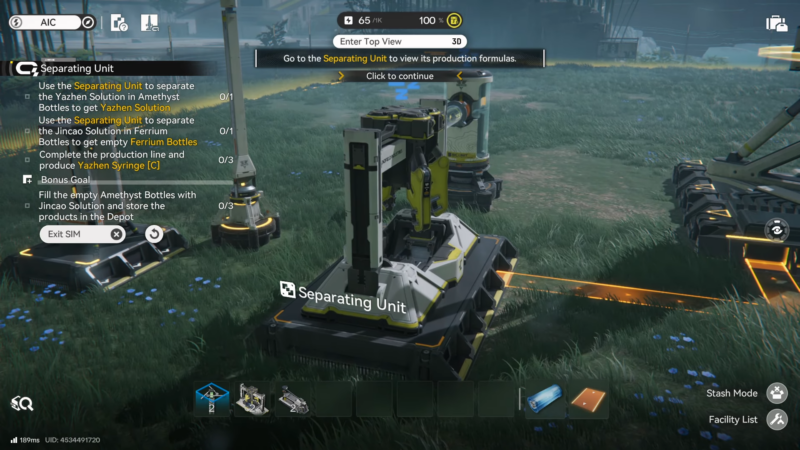
Connect the provided resource source/unload point to the Separation Unit’s input(s) using transport belts.
Step 2
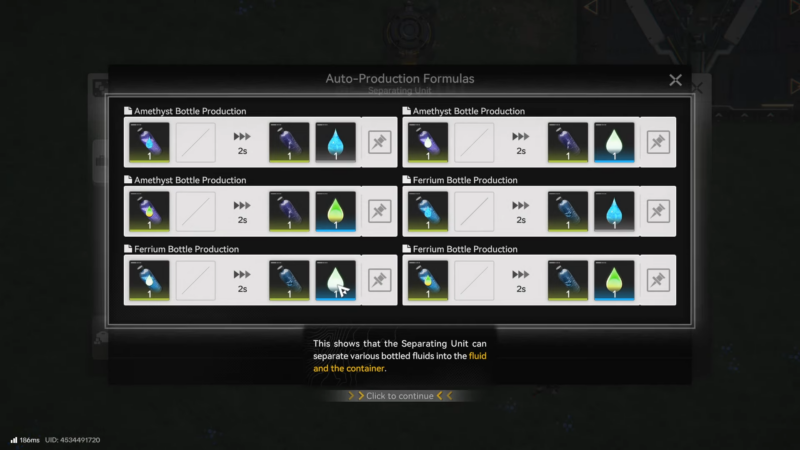
Route the Separation Unit’s output to the next required processing/storage destination so the production chain is complete end-to-end.
Step 3
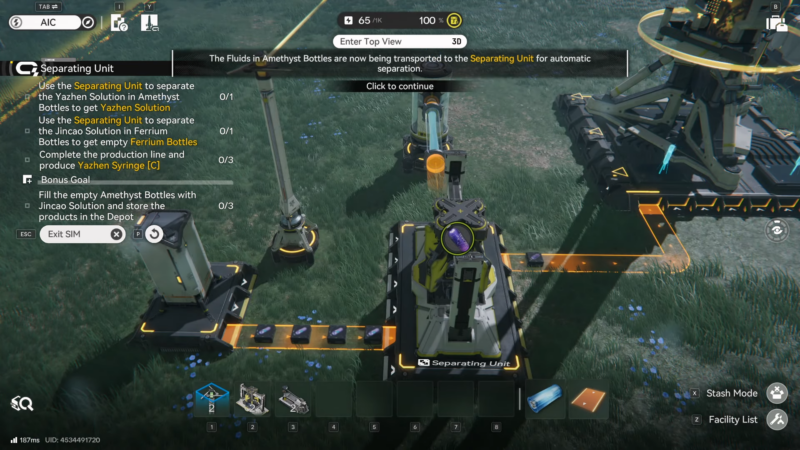
Ensure all facilities in the chain are powered, then confirm belts are moving continuously with no pauses at junctions.
Step 4
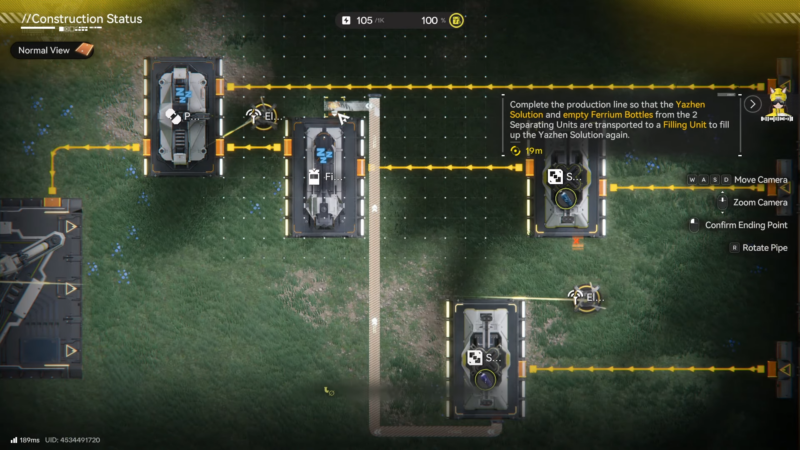
Let the line run and watch for periodic stops; if any machine pauses, fix the upstream starvation or downstream blockage until output remains steady.
Step 5
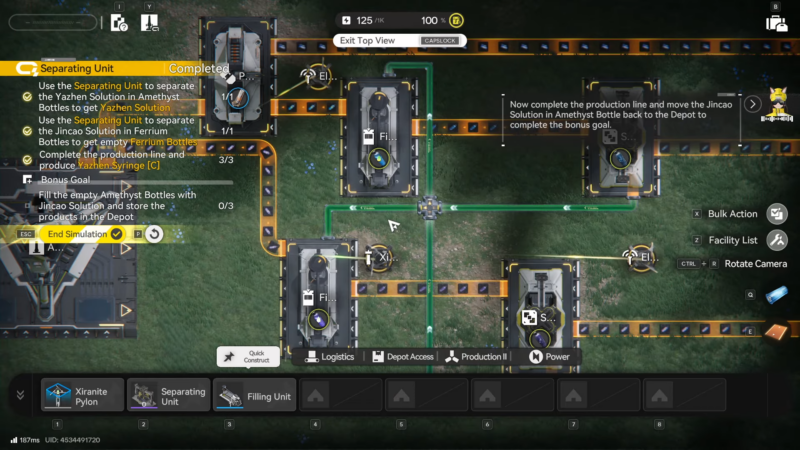
Once the main objective is satisfied, keep the line running long enough for the Bonus Goal condition to register as stable (if the simulation’s bonus is stability-based).
Practical stability tips that help Bonus Goals clear
A stable line is usually achieved by reducing “swing” in both supply and demand. On the supply side, that means ensuring each input belt is consistently fed and not competing with another machine for the same limited source. On the demand side, it means giving outputs enough belt capacity and storage/buffer space so nothing ever has to pause because the next segment is full.
If any stage takes two inputs, treat it as the most sensitive point in the chain. One missing ingredient can make the entire line appear active (belts moving in places) while the critical machine idles just often enough to prevent the bonus from counting. A quick way to diagnose is to watch the first machine that stops; it’s usually either lacking an input or unable to push an output.
Final notes for the Separation Unit Simulation
A clean clear comes from completing the line and ensuring the final output reaches the correct endpoint, while the Bonus Goal is usually secured by eliminating every small pause until production becomes reliably steady. If progress toward the bonus feels inconsistent, the fix is almost always mechanical: power, input starvation, output blockage, or a junction/belt direction mistake.