
What to know
-
WhatsApp is rolling out “Group Message History,” allowing new group members to see a selection of past messages.
-
Existing members can share 25 to 100 recent messages with newcomers, giving them instant context.
-
Admins can restrict who can share message history and how long people can scroll back.
-
The feature is end‑to‑end encrypted and adds a subtle notification when history is shared.
-
This change gives WhatsApp a clear edge over iMessage and, in some respects, even Telegram when it comes to group handling.
WhatsApp is quietly removing one of the most annoying quirks in group‑chat design: the fact that new members arrive with no idea what the group was just talking about. Meta’s messaging app is introducing a feature called Group Message History, which lets new participants see a slice of recent conversation as soon as they join, instead of staring at a blank scroll of messages.
How Group Message History improves Group Chat
For years, joining an existing WhatsApp group meant missing context unless someone manually forwarded old messages or copied and pasted key points. That workaround often led to messy chats, repeated questions, and a cluttered camera roll full of screenshots. Group Message History is designed to end that by giving new members a small but meaningful window into what has already been discussed.
How Group Message History works
The feature works by letting existing group members choose to share a portion of the chat’s history—between 25 and 100 messages—with anyone newly invited. Users can tap a “Share recent messages” prompt when adding someone and then decide how far back the new member should be able to scroll. After that, the newcomer can read those messages like any other part of the chat, with the usual end‑to‑end encryption intact.
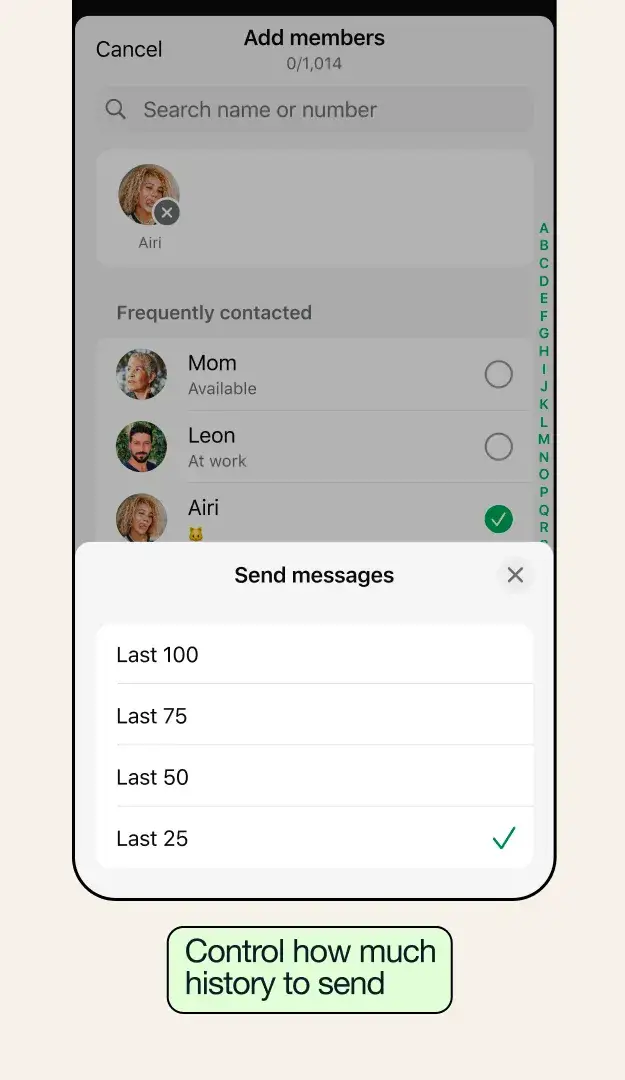
Administrators can also set who is allowed to share message history, limiting the option to admins only if a group wants stricter control over what new members see. WhatsApp has explicitly framed this as a privacy‑conscious move: because people won’t gain access to the entire conversation, there’s less risk of older, sensitive content resurfacing in ways members didn’t anticipate.

Another subtle but useful detail is that WhatsApp notifies the group when message history is shared, including the timestamp and the sender who triggered it. That notification appears in a slightly different style from regular messages, so everyone can see that someone has just brought a new member up to speed. This transparency helps avoid confusion and keeps the group on the same page without anyone having to ask, “What did I miss?”
How does it compare with iMessage and Telegram?
Compared with rivals, this update gives WhatsApp a noticeable advantage. iMessage still offers no built‑in way for new participants to see prior messages, which means iPhone users often have to rely on screenshots, forwards, or third‑party workarounds. Telegram, on the other hand, lets new members see the full chat history by default, but it does not provide the same level of selective control; admins can’t easily limit how far back newcomers can scroll or restrict who can share which messages.
WhatsApp’s blending of selective history, admin controls, and end‑to‑end encryption lands in a middle ground that many users may find more comfortable than Telegram’s all‑or‑nothing approach and more modern than iMessage’s current limitations. For work chats, school groups, or family threads where clarity and context matter, Group Message History can save time and reduce friction every time someone new joins.
The rollout is gradual, so not every account will see the option immediately, but once it lands, it is likely to become one of those quietly indispensable features that people rely on without even thinking about it. Over time, this could make WhatsApp feel more cohesive and less fragmented than alternatives, especially for users who regularly rotate members in and out of the same group.