- What to know
- Nioh 3 Stat scaling transition
- Why 55 points acts as the soft cap
- Evidence from Odachi and Hatchet scaling tests
- When to switch to your secondary stat in Nioh 3
- Understanding scaling grades and stat synergy
- Practical example for your build
- Should you ever go beyond 55 in primary?
- Finding your weapon’s true damage balance
What to know
- 55 points in your primary weapon scaling stat acts as a soft cap.
- Damage gains after 55 show clear diminishing returns.
- Switching to a secondary scaling stat after 55 yields better value.
- Testing across weapons like Odachi and Hatchets confirms this trend.
Understanding stat scaling is one of the most important progression decisions you make in Nioh 3. You naturally want to pour every point into your weapon’s highest scaling attribute, but detailed player testing shows that blindly stacking your primary stat past a certain threshold is inefficient.
The data gathered from multiple high-level builds indicates a consistent breakpoint: 55 points in your primary scaling stat. At this point, the weapon’s attack growth slows noticeably, creating what many players now consider the true soft cap for primary scaling.
Below, you’ll see how this works in practice, how it affects different weapons, and when you should pivot into your secondary stat for optimal returns.
Nioh 3 Stat scaling transition
| Investment Stage | Primary Stat Investment | Damage Growth Efficiency | Recommended Action |
|---|---|---|---|
| Early Game | 1–30 | Very High | Focus on primary stat |
| Mid Game | 30–55 | Strong | Continue stacking primary |
| Post-Soft Cap | 55+ | Diminishing returns | Begin investing in secondary |
| Late Optimization | 55 Primary + 30–50 Secondary | Balanced scaling | Hybrid investment |
The key takeaway is simple: 55 is the sweet spot for primary scaling efficiency.
Why 55 points acts as the soft cap
Weapon scaling in Nioh 3 follows a diminishing returns model. Each weapon has a primary scaling stat, a secondary stat, and sometimes a tertiary stat. Early investment produces large increases to melee attack, but once you approach the mid-50s, the growth curve flattens.

Testing across different weapon classes shows the same pattern. Between levels 1 and 30 in your primary stat, each point can provide significant attack gains. Between 30 and 55, growth remains strong but slightly tapered. After 55, however, each additional point provides noticeably less attack than earlier levels.
What makes 55 important is that it represents the point where further primary investment begins to underperform compared to investing in a secondary scaling stat.
Evidence from Odachi and Hatchet scaling tests
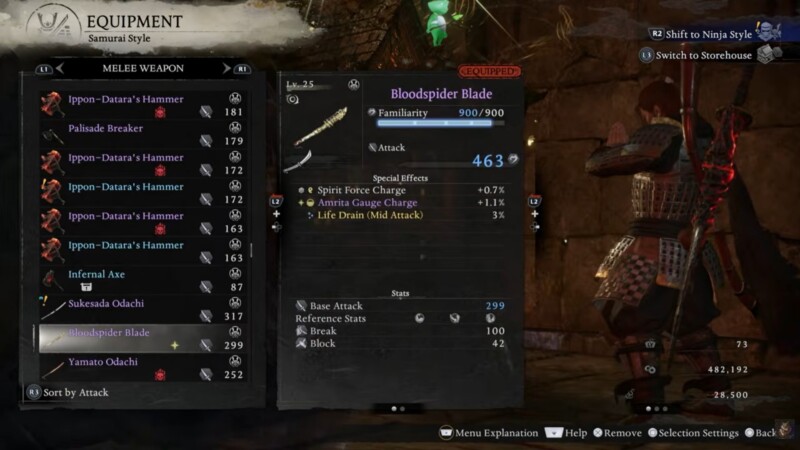
The Odachi, which typically scales heavily with a Strength-type primary stat, demonstrates this clearly. When players tested melee attack values at various stat thresholds, they found that increasing Strength from 40 to 55 provided meaningful gains. However, pushing from 55 to 65 showed only marginal improvement compared to earlier levels.
Here is a simplified representation of scaling efficiency observed in testing:
| Strength Investment | Odachi Attack Increase Per Point | Efficiency Rating |
|---|---|---|
| 20 → 30 | High | Excellent |
| 30 → 40 | High | Strong |
| 40 → 55 | Moderate | Efficient |
| 55 → 65 | Low | Diminishing |
The drop in per-point value after 55 is consistent enough that continuing to stack Strength becomes less optimal than diversifying into the Odachi’s secondary stat.
Hatchets, which often scale with Skill or Dexterity as primary, show a nearly identical pattern. When pushing the primary stat to 55, players observed the strongest return on investment. Beyond that threshold, gains per point decreased significantly.
This cross-weapon consistency suggests that 55 is not weapon-specific, but rather part of a broader scaling formula built into Nioh 3’s stat system.
When to switch to your secondary stat in Nioh 3
Once you reach 55 points in your primary scaling stat, the optimal move is to redirect new level-ups into your weapon’s secondary scaling stat.
Why does this work?
Because secondary stats are still in their high-efficiency growth phase. While your primary stat has entered diminishing returns territory, your secondary stat is still offering strong per-point attack increases.
For example:
| Build Scenario | Primary | Secondary | Total Attack Outcome |
|---|---|---|---|
| Overstacked | 65 Primary | 20 Secondary | Lower total efficiency |
| Balanced | 55 Primary | 35 Secondary | Higher overall attack |
| Hybrid Optimized | 55 Primary | 45 Secondary | Best scaling return |
The balanced distribution consistently outperforms excessive primary stacking.
Understanding scaling grades and stat synergy
Each weapon lists scaling grades such as A, B+, or C. Naturally, you assume the highest grade should receive maximum investment. However, scaling grades affect growth multipliers, not diminishing return thresholds.
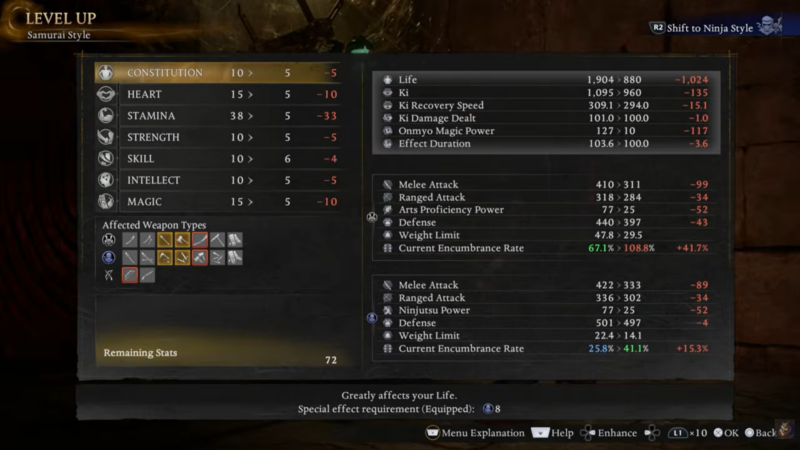
That means even if your weapon has A scaling in Strength, the diminishing return curve still applies. Once you cross 55, that A scaling no longer compensates for the reduced per-point efficiency.
Secondary stats, even with slightly lower scaling grades, become more attractive once your primary stat reaches the soft cap.
What about tertiary stats?
Testing on tertiary stats remains less conclusive. Early findings suggest tertiary stats generally provide weaker returns compared to primary and secondary investments. However, in ultra-high-level builds, investing into tertiary scaling after both primary and secondary stats reach strong thresholds can still produce incremental gains.
The general progression pattern looks like this:
| Optimization Phase | Stat Focus |
|---|---|
| Early Build | Primary only |
| Mid Optimization | Primary to 55 |
| Late Optimization | Secondary scaling growth |
| Min-Max Phase | Minor tertiary adjustments |
For most players, tertiary investment becomes relevant only in NG+ cycles or extremely high character levels.
Practical example for your build
Imagine you are running an Odachi build. You push Strength to 55. At that point, instead of continuing to 70 Strength, you begin investing in your secondary stat, perhaps Skill or Stamina depending on the weapon scaling.
By distributing points this way, you achieve a higher overall melee attack compared to stacking Strength alone.

The same principle applies if you are using Hatchets, Dual Swords, or any other weapon class. Once your primary stat reaches 55, you shift gears.
Damage calculation in Nioh 3 multiplies your weapon’s base attack through scaling, buffs, familiarity, and effects. If your base attack increases more efficiently through balanced stat investment, all multipliers benefit.
This means:
- Stronger Yokai Shift damage.
- Higher burst damage during buff windows.
- More effective Ki damage conversions.
- Faster boss kill times.
Even small efficiency differences compound heavily in endgame builds.
Should you ever go beyond 55 in primary?
There are exceptions. Certain armor requirements, guardian spirit bonuses, or build thresholds may justify pushing your primary stat higher temporarily. However, from a pure melee attack efficiency standpoint, 55 remains the optimal pivot point.
If your goal is maximum weapon damage scaling per level invested, switching to your secondary stat after 55 consistently produces better results.
The optimal stat transition strategy explained
The safest and most efficient stat progression path in Nioh 3 looks like this:
You focus heavily on your weapon’s primary scaling stat early on. You push it aggressively to 55. Once there, you redirect all additional offensive stat points into your secondary scaling stat. Only after both are well-developed should you consider tertiary scaling or additional utility stats.
This balanced approach consistently yields higher total melee attack than over-investing into a single attribute.
Finding your weapon’s true damage balance
Stat optimization in Nioh 3 rewards precision. The difference between an overstacked primary stat and a balanced primary-secondary distribution may look small on paper, but in combat, it translates into measurable improvements.
If you are unsure whether you have crossed the soft cap, check your melee attack before and after leveling. When the increase per stat point noticeably shrinks, you are likely at or beyond the 55 threshold.
At that moment, shifting to your secondary scaling stat is not just recommended. It is mathematically efficient.