
What to know
- Qualcomm has unveiled FastConnect 8800 systems built around Wi-Fi 8, delivering up to ~11.6 Gbps peak data rates and extended range.
- Wi-Fi 8 (IEEE 802.11bn) shifts emphasis from raw speed to ultra-high reliability, low latency, and consistency in real-world networks.
- Qualcomm’s Wi-Fi 8 chips integrate multiple radios and standards (Wi-Fi 8, Bluetooth 7, UWB, Thread) for smarter multi-device ecosystems.
- Consumer and router products based on these early Wi-Fi 8 platforms are expected to surface before the formal standard’s finalization around 2028.
The next generation of wireless — officially known as IEEE 802.11bn and branded Wi-Fi 8 — is being developed with a very different priority than earlier Wi-Fi versions. Instead of focusing mainly on peak throughput numbers, it aims for ultra-high reliability, low and predictable latency, and smooth performance in crowded, interference-prone environments — the real conditions most users experience.
This means your connection should stay stable even when many devices are active, and transitions between access points should be seamless. That’s especially important for immersive experiences like AR/VR, industrial IoT, cloud gaming, and real-time collaboration.
At MWC 2026, Qualcomm announced its FastConnect 8800 mobile connectivity system — the first chip family designed to support Wi-Fi 8 alongside other modern wireless standards in a single package. This includes:
- Wi-Fi 8 (802.11bn) with support for up to ~11.6 Gbps peak data rates.
- Bluetooth 7, with higher data throughput for audio and transfers.
- Ultra Wideband (UWB) and Thread 1.5 for precise location services and IoT networking.
That integration simplifies hardware design for phones, tablets, XR headsets, and laptops while boosting performance, coverage, and efficiency.
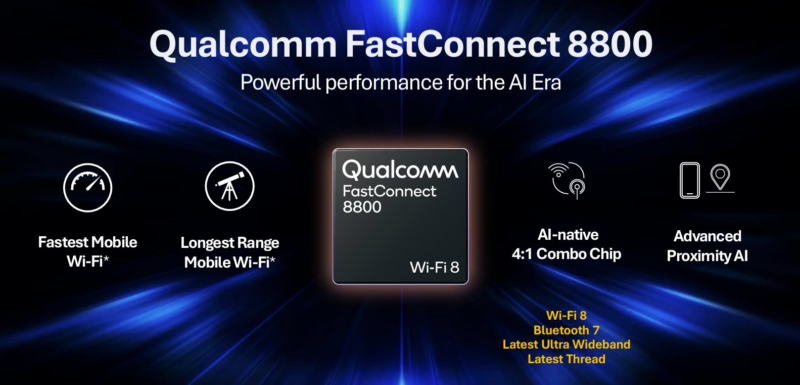
Wi-Fi 8’s focus on reliability and consistent experience comes from both standard-level innovations and Qualcomm’s implementation:
- Qualcomm’s chips use a 4×4 radio configuration (more antennas) to increase effective throughput and extend high-speed coverage farther from the access point.
- The technology is engineered to deliver up to three times the gigabit-range of previous FastConnect products, helping maintain multi-gig performance throughout more of your home or office.
In practical terms, you won’t just see higher maximum numbers near the router — the connection quality deep into corners and around obstacles should improve too.
Qualcomm is positioning Wi-Fi 8 as AI-native connectivity. That means using machine intelligence to help manage the network — from adapting to interference and congestion to optimizing performance on the fly — rather than leaving those tasks solely to the traditional Wi-Fi protocol.
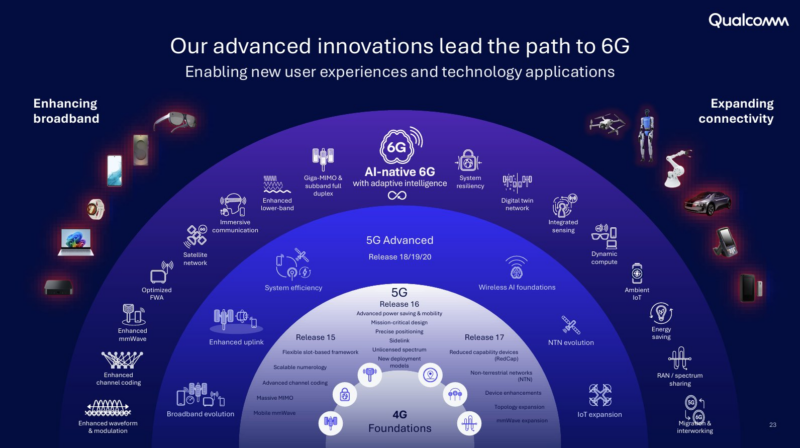
Qualcomm’s platforms include features that can analyze signal environments, better coordinate multiple access points, and fine-tune performance for different uses, such as gaming or large file transfers — making connections more predictable and efficient in real conditions.
The Wi-Fi 8 standard itself isn’t expected to be finalized until around 2028, with certification and broad rollout following. However, Qualcomm and other industry partners are already testing and validating early implementations, which often appear in products well before formal standard ratification.
Importantly, Wi-Fi 8 chips like FastConnect 8800 are backward compatible with existing Wi-Fi 7 and older networks, so you’ll still connect normally — you just get the benefits when paired with newer infrastructure and devices that support the new features.