What to know
-
Buck Capsule C is a 3★ HP food buff that restores 470 HP, with auto-use below 60% HP and a max of 3 uses per battle.
-
A double-line layout helps avoid “odd leftover” buckflower powder issues because some steps produce in pairs.
-
For full-speed operation, plan for 120 amethyst ore per minute and roughly 140 power for the complete module set.
-
Buck Capsule C production is commonly used as an early-game Stock Bill earner via outposts/camps (trade loops), so scaling and modular stacking matter.
In Arknights: Endfield, you can build a compact, fully automated Double Buck Capsule C line by pairing amethyst processing with a self-sustaining buckflower loop so your inputs stay balanced and the output never clogs.

You’re basically building two identical Buck Capsule C lines side-by-side, sharing sensible routing so every intermediate is consumed at the rate it’s produced. The goal is simple: stable inputs, stable power, and no stalled belts due to storage caps or mismatched ratios.
| Topic | Recommended approach |
|---|---|
| Output goal | Produce Buck Capsule C continuously with a doubled (two-at-once) layout to keep buckflower powder consumption even. |
| Primary input | 120 amethyst ore/min for full efficiency on the shown compact module. |
| Plant input | Keep at least 1 buckflower available to start; keep a buffer (example: ~50) but don’t hit storage cap. |
| Power budget | About 140 power to run the whole module at full efficiency. |
| Footprint | About 15 blocks wide by 25 blocks tall for the compact design. |
| Delivery | Route finished items into a Protocol Stash for transport back to base. |
Buck Capsule C basics
Buck Capsule C can be used directly from your backpack to restore HP, or equipped for automatic use when an operator drops below 60% HP. It restores 470 HP per use, has a max of 3 uses per battle, and can additionally support your controlled operator once per battle under similar conditions.
How to set up Double Buck Capsule C production without clogging
This layout works best when you treat it as two synchronized production lines that share the same logic: amethyst becomes bottle components, buckflower becomes powder, and both feed the final filling stage twice in parallel.
Step 1: Lock your input targets before you place anything
Decide whether you’re truly running “full efficiency,” then commit to feeding 120 amethyst ore per minute into the module.

If you can’t sustain that ore rate yet, build the line anyway but expect idle time rather than trying to “fix” it with extra machines that will just desync your ratios.
Step 2: Build the amethyst-to-bottle chain first
Feed amethyst ore into refining units to create amethyst fibers.

Then send fibers into molding units to form bottles.

The key ratio callout here is that molding consumes 2 inputs to produce 1 bottle, so route two fiber feeds into each molding unit to avoid starving it. Split the finished bottles cleanly across the two filling units (one per line) so each capsule line gets a predictable bottle supply.
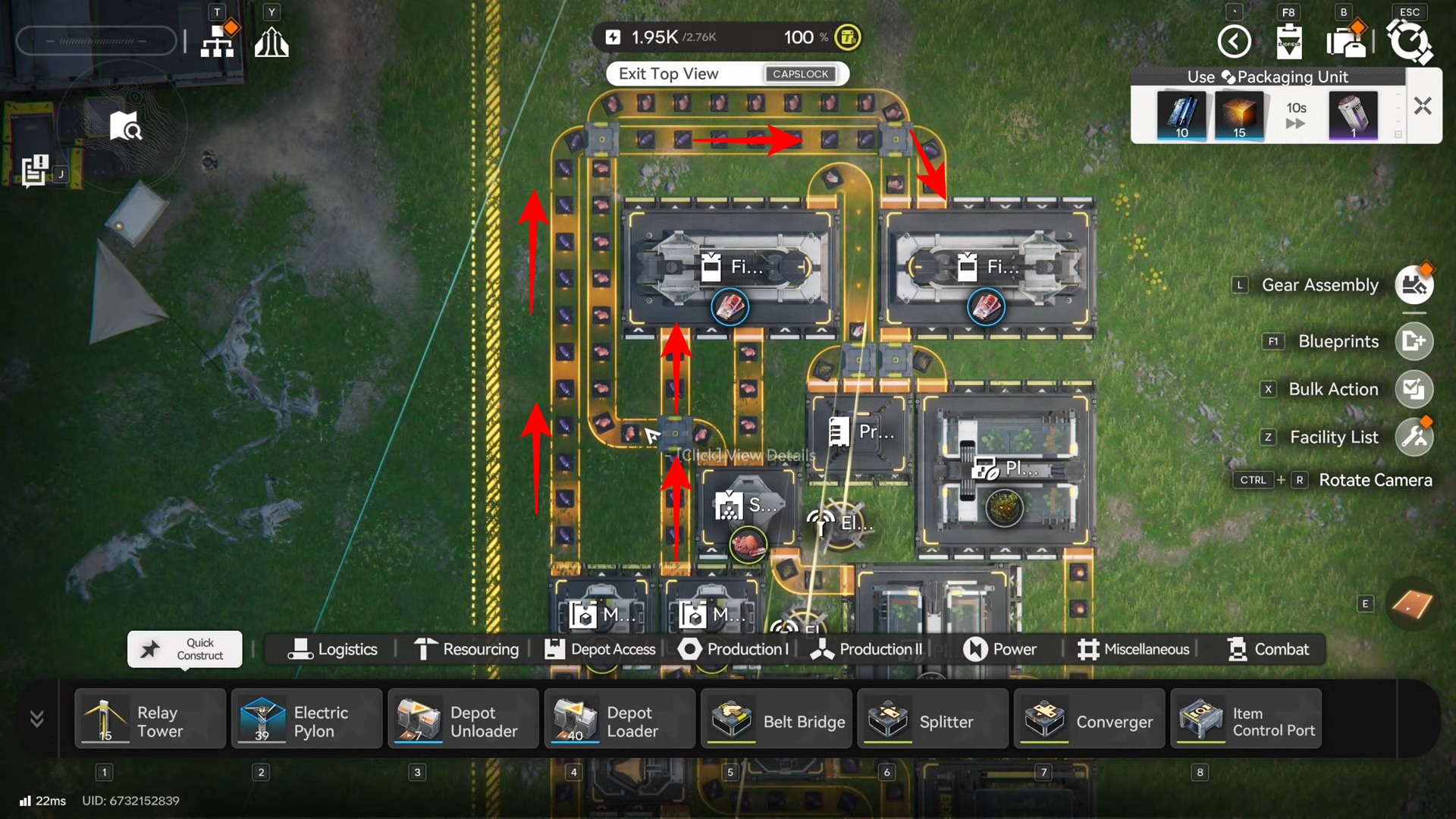
Step 3: Create a self-sustaining buckflower loop (seed → plant → powder → regrowth)
Start with a buckflower in storage so you can seed and scale the loop. Use duplication (one buckflower into two seeds) so one seed feeds a planter for shredding and the other goes through a “recycling/decycling” path that returns a bush/plant back into storage so the loop can continue. This keeps the line running with minimal manual restocking once it’s stable.
Step 4: Split buckflower powder evenly to both filling units
Because buckflower powder production tends to come in even chunks (two at a time), a single-line capsule build can leave awkward leftovers. By running a double capsule line, you naturally consume powder in a way that matches that “paired” output and reduces waste or belt clutter.

Step 5: Send both final outputs into the Protocol Stash
Route both Buck Capsule C outputs into a Protocol Stash so they’re transported back to base on the regular interval.

This also simplifies scaling: when you add another identical module, you’re just adding another pair of outputs into the same logistics concept.
Step 6: Prevent the most common stop condition (plant storage cap)
You want “enough” buckflower available to keep everything smooth (an example buffer is 50), but if you hit your storage cap, the plant slots can fill and the whole machine can stop. Watch your plant counts early on, then adjust by consuming/selling excess, adding storage room, or temporarily pausing the plant portion so it doesn’t overflow.
Step 7: Verify your power headroom
If your grid can’t sustain the module’s full load (about 140 power), you’ll see intermittent downtime or full shutdown once reserves drain. Stabilize power before you judge throughput, because “ratio problems” often end up being “power problems.”
How to scale this into a “money module” safely
Keep the footprint consistent (about 15×25 for the compact version) so you can tile multiple copies without overlapping routes. Scale ore supply first (so every module can actually receive 120 amethyst ore/min), then scale power, and only then stamp down more modules. If you scale plants too aggressively, you’ll run into storage-cap stalls, so treat the buckflower loop as “just enough to feed” rather than “as much as possible.”
Final checks before you leave it running overnight
Make sure both filling units are receiving bottles and powder, and confirm both outputs are successfully entering the Protocol Stash. Confirm you’re not approaching a plant storage cap, because that’s an easy silent failure that looks like a belt issue. Finally, confirm your grid can sustain the ~140 power draw continuously rather than only from short-term reserves.
If you build Buck Capsule C as a doubled line, you get cleaner ratios, fewer leftovers, and an easier time scaling into trade-focused production. Once your ore and power are stable, the setup is largely hands-off—just keep an eye on plant storage limits and your logistics output path.