- What to know
- Setting up your farm layout in Wuling City
- How watering and germination actually work
- Understanding crop yields and tactical crafting value
- Infrastructure efficiency and power grid considerations
- Maximizing hourly returns without overinvestment
- Farming in Arknights: Endfield made practical
What to know
- Farming is unlocked and managed in Wuling City, where you grow crops for tactical crafting.
- The farm supports a maximum of 20 plots, with strict spacing rules.
- Each crop cycle takes one hour, including manual germination and sprinkler watering.
- Full optimization yields around 40 Fluff Ginkgo per hour, enough for steady purple-tier crafting.
Farming in Arknights Endfield is not just a side activity. If you want a consistent supply of tactical crafting materials without relying entirely on exploration or combat drops, the farm system in Wuling City becomes a core part of your progression loop. Once you understand the layout constraints, watering mechanics, and growth timing, you can turn it into a steady production line for key items.
Below is a quick glance at how farming works before we break it down in detail.
Farming system overview
| Element | Requirement / Limit | Key Notes |
|---|---|---|
| Farm Location | Wuling City | Dedicated farming zone |
| Maximum Plots | 20 | Hard cap despite visible space |
| Plot Spacing | 3-square gap required | Cannot place plots directly adjacent |
| Sprinkler Coverage | 2 plots per sprinkler | 10 sprinklers needed for full capacity |
| Water Source | Pipeline + Water Tank | 10 sprinklers are needed for full capacity |
| Growth Cycle | 1 hour total | Two watering phases |
| Fertilizer Effect | -1 minute | Generally inefficient |
| Average Yield | ~40 Fluff Ginko/hour | From 20 plots |
Setting up your farm layout in Wuling City
The farming zone is fixed inside Wuling City, and while it visually appears spacious, the system enforces a strict 20-plot maximum. Even if you try to extend further, the cap prevents additional placement.
Plots must be crafted using seeds and carbon, making your initial expansion slightly resource-dependent. Once crafted, each plot requires a three-square space between others, which limits how tightly you can cluster them. This spacing rule is what prevents players from exceeding the practical density limit.
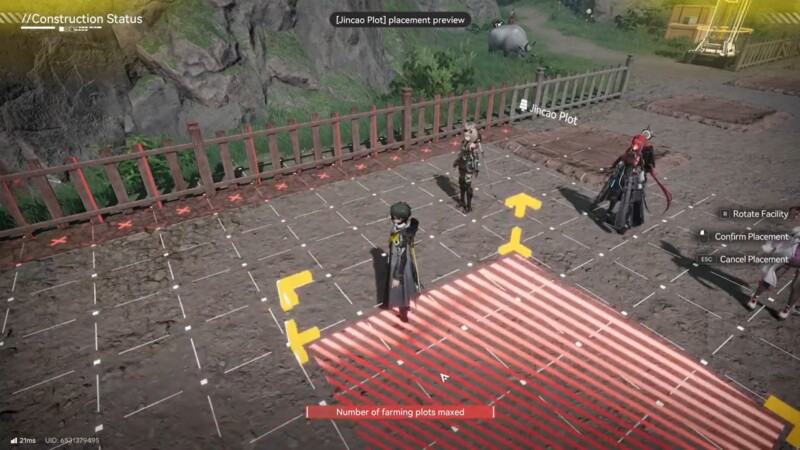
When designing your layout, efficiency comes from symmetry. A balanced grid ensures your sprinkler coverage remains optimal and reduces pipeline complexity.
Optimal farm configuration
| Component | Quantity for Max Efficiency | Function |
|---|---|---|
| Crop Plots | 20 | Maximum allowed |
| Sprinklers | 10 | Each covers 2 plots |
| Water Tank | 1 (minimum) | Stabilizes water supply |
| Pipeline Connections | Single network | Connect all sprinklers |
| Power Grid Link | Optional but recommended | Activates automated systems |
Although sprinklers only manage watering, connecting the entire system through a unified pipeline simplifies maintenance and prevents supply interruptions. A water tank is strongly recommended to avoid inconsistencies in flow.
How watering and germination actually work
One important detail many players miss is that sprinklers do not initiate growth. You must manually germinate each plot first. Without this step, the sprinkler system does nothing.
After germination, the process follows a predictable timing structure.
Crop growth cycle breakdown
| Phase | Duration | Player Involvement |
|---|---|---|
| Manual Germination | Instant | Required |
| First Watering Phase | Automatic | Sprinkler-driven |
| First Growth Phase | 30 minutes | Passive |
| Second Watering Phase | Automatic | Sprinkler-driven |
| Second Growth Phase | 30 minutes | Passive |
| Total Time | 60 minutes | Harvest-ready |
Each full cycle lasts exactly one hour. Once you germinate and ensure sprinklers are active, the rest proceeds automatically.
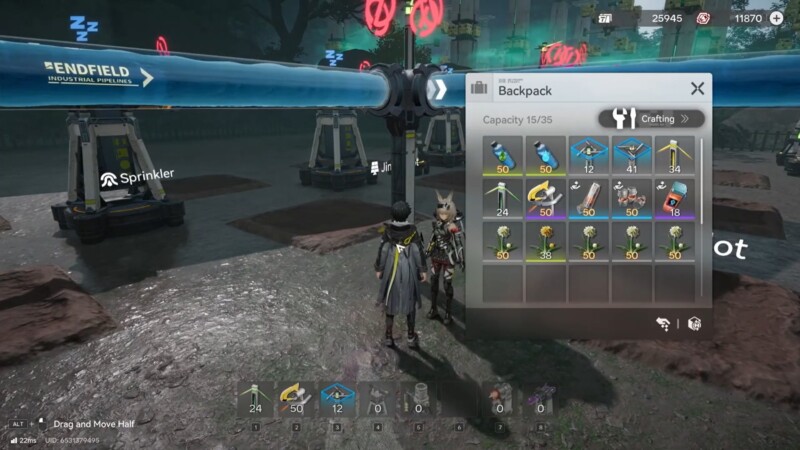
Fertilizing is technically possible, but it only reduces total growth time by one minute. Considering the resource input required for fertilizer production, the return on investment is extremely low. In practice, it is not worth using unless you have surplus materials.
Understanding crop yields and tactical crafting value
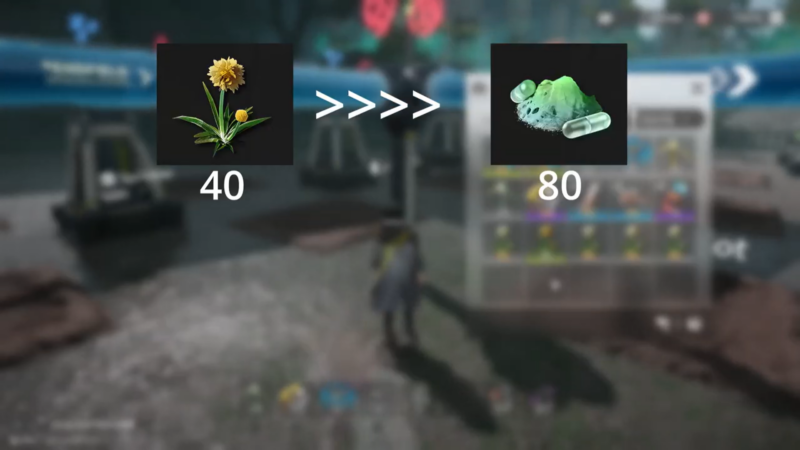
A fully optimized 20-plot farm produces approximately 40 Fluff Ginko per hour on average. This number can vary slightly depending on efficiency and timing, but it serves as a reliable baseline.
From that output:
| Resource Conversion | Output |
|---|---|
| 40 Fluff Ginko | 80 Powders |
| 80 Powders | 16 Jinote Sane (Purple) |
The purple-quality tactical item Jinote Sane provides meaningful value relative to its material cost. In contrast, crafting orange-quality variants demands significantly higher input for only marginal increases in HP restoration. Because of that imbalance, purple-tier crafting remains the most efficient use of farmed materials.
If you’re aiming for sustainable tactical stockpiles rather than min-max burst healing, maintaining a stable Fluff Ginko loop is the smarter long-term strategy.
Infrastructure efficiency and power grid considerations
Although sprinklers function independently of the power grid once supplied with water, connecting them to your broader infrastructure can streamline operations. If your base systems are centralized, tying your farm into the grid allows smoother management when expanding other industrial systems.
The key principle is consistency. A single pipeline feeding all ten sprinklers reduces failure points. Fragmented water systems create unnecessary complications and increase downtime risk.
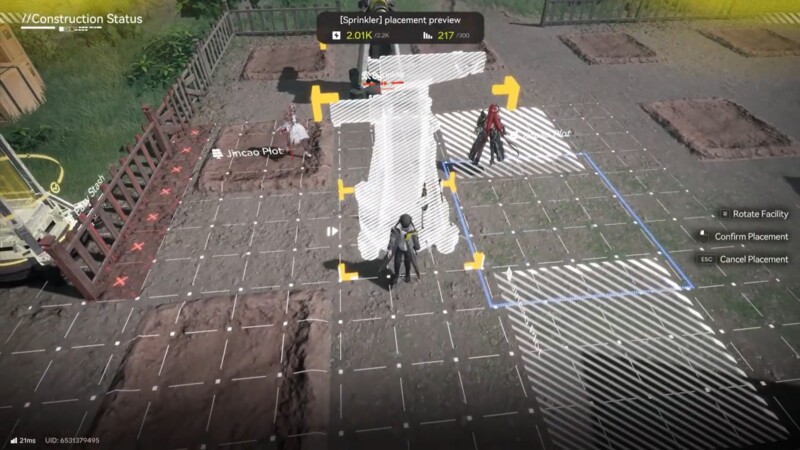
You should also avoid overcomplicating layout expansions. Since the farm cannot exceed 20 plots, optimizing within that cap matters more than attempting to scale outward.
Maximizing hourly returns without overinvestment
Given the one-hour growth loop, the farm is best treated as a timed background system. You germinate, ensure sprinklers are active, and return after sixty minutes for harvesting.
Over a multi-hour session, this provides steady passive production without draining exploration time. Since fertilizer only trims one minute from the cycle, skipping it preserves materials for more impactful crafting systems.
Efficiency comes from rhythm. Germinate consistently, harvest on schedule, and reinvest Fluff Ginko into powder conversion immediately to maintain production flow.
Farming in Arknights: Endfield made practical
Farming in Arknights: Endfield is a controlled, infrastructure-driven system rather than a traditional agricultural simulation. You operate within a strict 20-plot limit, rely on sprinklers covering two plots each, manually trigger germination, and wait through a structured one-hour growth cycle. When optimized, the system yields roughly 40 Fluff Ginko per hour, translating into steady purple-tier tactical crafting.
If you treat your Wuling City farm as a timed production module instead of a primary gameplay loop, it becomes one of the most reliable resource pipelines in the game.