What to know
- Steel Parts are a downstream industrial product, meaning inefficiencies compound quickly if earlier stages are unstable.
- Power distribution is just as important as material flow, especially once fitting units are added.
- Ferrium and Sandleaf must remain balanced throughout the chain to prevent silent production stalls.
- A modular factory layout is essential if you want to scale Steel Parts without rebuilding everything later.
Steel Parts production in Arknights Endfield represents a major shift from simple refinement into true industrial manufacturing. While Steel itself already requires multiple conversion stages, Steel Parts introduce an additional transformation layer that magnifies every design flaw in your base. Poor placement, uneven power routing, or mismatched throughput will all show up here first.
This guide focuses on building a reliable, expandable Steel Parts production factory blueprint that prioritizes consistency over short-term output spikes. Instead of rushing machines together, the layout described here is designed to remain functional as your base grows, steel demand increases, and more advanced production chains come online.
(Refining Unit)
(Shredding Unit)
Dense Ferrium Powder
(Grinding Unit)
(Refining Unit)
(Fitting Unit)
Steel Parts production chain explained
| Stage | Unit involved | Input materials | Output material | Strategic importance |
|---|---|---|---|---|
| Raw conversion | Refining Unit | Ferrium Ore | Ferrium | Stabilizes mineral flow |
| First refinement | Refining Unit | Ferrium | Ferrium Powder | Sets base throughput |
| Organic processing | Shredding Unit | Sandleaf | Sandleaf Powder | Balances mixed inputs |
| Material fusion | Grinding Unit | Ferrium Powder + Sandleaf Powder | Dense Ferrium Powder | Core bottleneck |
| Metal refinement | Refining Unit | Dense Ferrium Powder | Steel | High power demand |
| Parts assembly | Fitting Unit | Steel | Steel Parts | Final production output |
How to build the Steel Parts production process step by step
Step 1: Converting ferrium ore into ferrium
The process begins with Ferrium Ore, which is converted into Ferrium through your base’s Refining Unit. This step defines how much potential throughput your entire factory can achieve. Any interruptions here cap everything downstream.
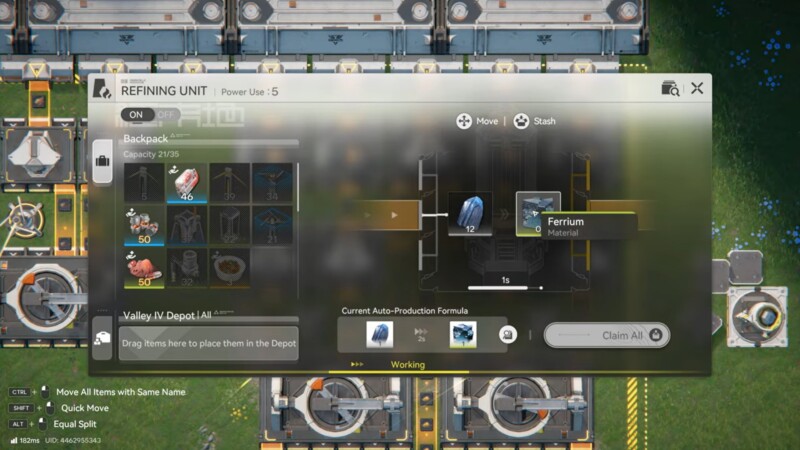
Ensuring consistent ore intake and buffering ferrium before refinement helps absorb short-term fluctuations.
Step 2: Refining ferrium into ferrium powder
Ferrium is then processed in a Refining Unit to produce Ferrium Powder. This conversion should run continuously. If ferrium powder production exceeds grinding capacity, storage buffers can help, but overproduction is still inefficient.

Step 3: Processing sandleaf into sandleaf powder
In parallel, Sandleaf is sent through a Shredding Unit to create Sandleaf Powder. This stage must remain synchronized with ferrium powder output. Slight underproduction here can stall the grinder, while overproduction wastes space and logistics capacity.

Step 4: Producing dense ferrium powder in the grinding unit
The Grinding Unit combines Ferrium Powder and Sandleaf Powder into Dense Ferrium Powder. This step should be monitored closely, as it reflects the health of the entire factory.

Step 5: Refining dense ferrium powder into steel
Dense ferrium powder is then processed in a second Refining Unit to produce Steel. This stage has higher power demand than earlier refinement steps, making pylon placement especially important.

Steel should flow directly toward the fitting unit without unnecessary detours.
Step 6: Converting steel into steel parts in the fitting unit
Finally, Steel is processed in a Fitting Unit to produce Steel Parts. This is the culmination of the entire chain. Because Steel Parts are often consumed immediately by advanced construction or automation, delays here are immediately noticeable in gameplay.

A direct, low-latency connection between steel refining and fitting ensures maximum efficiency.
Layout philosophy for long-term scalability
The most reliable Steel Parts factory uses a layered or U-shaped layout, with raw materials entering from one side, converging at the grinding unit, and exiting as Steel Parts on the opposite side. This structure keeps logistics directional and makes future expansion predictable.
When demand increases, you can replicate the grinding–refining–fitting segment without touching the earlier stages, preserving factory uptime.
Core parts of the Steel Parts factory blueprint
Refining units as entry and exit gates
The Refining Unit plays two distinct roles in this blueprint. Early in the chain, it converts Ferrium into Ferrium Powder. Later, it converts Dense Ferrium Powder into Steel. Treating these as interchangeable machines is a common mistake.
The first refining unit should be positioned close to ferrium intake and storage, ensuring uninterrupted conversion. The second refining unit, however, belongs closer to the Fitting Unit, since steel rarely needs long-term storage and is often consumed immediately.
Separating these refining stages spatially helps reduce congestion and keeps material flow directional rather than circular.
Shredding unit
The Shredding Unit exists solely to process Sandleaf into Sandleaf Powder, but its influence extends far beyond that single conversion. Sandleaf inputs tend to fluctuate based on harvesting conditions, making this stage one of the most common sources of production instability.
The shredding unit should be placed near the grinding unit to minimize transport delays. While it consumes relatively little power, its output consistency directly affects dense ferrium production, making its placement more important than its raw speed.
Grinding unit
The Grinding Unit combines Ferrium Powder and Sandleaf Powder into Dense Ferrium Powder, making it the most sensitive and most important structure in the entire factory.
Every upstream imbalance becomes visible here. If ferrium powder arrives faster than sandleaf powder, the grinder idles. If power flickers, dense ferrium production halts immediately. For this reason, the grinding unit should sit at the center of the factory layout, surrounded by its input sources and directly connected to strong power lines.
Many players attempt to solve dense ferrium shortages by adding extra grinders, but in most cases, the real issue is input routing rather than capacity.

Electric pylons
Electric pylons are often treated as afterthoughts, but in Steel Parts production they are structural components, not utilities. Refining, grinding, and fitting units all draw sustained power, and short outages cause desynchronization across the chain.
The most stable approach is to run a central power spine, with pylons branching outward in short, symmetrical connections. Avoid long chains of pylons feeding multiple heavy units, as this increases the risk of cascading shutdowns under load.
Fitting unit and final assembly logic
The Fitting Unit is where Steel is converted into Steel Parts, completing the production chain. Unlike earlier stages, the fitting unit does not tolerate upstream instability well. If steel input pauses even briefly, overall Steel Parts output drops sharply.

Placing the fitting unit immediately downstream of the steel refining unit minimizes latency and prevents steel from clogging transport routes. From a layout perspective, the fitting unit should be treated as the endpoint, with clear outbound logistics to wherever Steel Parts are consumed.
Common pitfalls that reduce Steel Parts output
Most issues stem from imbalanced production ratios or power instability. Adding more machines rarely fixes the problem if materials arrive late or power delivery is inconsistent.
Another frequent mistake is placing the fitting unit too far from steel output, which introduces unnecessary transport delays and lowers effective throughput.
More blueprints for Arknights Endfield
This Steel Parts factory blueprint works because it respects how Arknights Endfield models industrial systems. It emphasizes flow, balance, and power stability over raw machine count, allowing the factory to scale naturally as your base grows.
Once built correctly, Steel Parts production becomes a background process rather than a constant optimization problem.