What to know
- Bluesky treats Live as a contextual signal, not a separate content format
- Real-time moments emerge from chosen feeds, not global algorithms
- Engagement prioritizes relevance and conversation quality over scale
- The platform avoids native livestream hosting to preserve clarity and control
Live features have become a defining battleground for modern social platforms. What once meant simple real-time posting has evolved into a broader question of how platforms surface immediacy, encourage participation, and shape attention. Against that backdrop, Bluesky appears to be approaching “Live” as a subtle layer that enhances how conversations unfold in the moment.
This distinction matters because the future of real-time interaction is no longer just about speed. It is increasingly about context, relevance, and user control, all areas where Bluesky’s Live direction shows careful intention rather than aggressive expansion.
What does Live mean on Bluesky
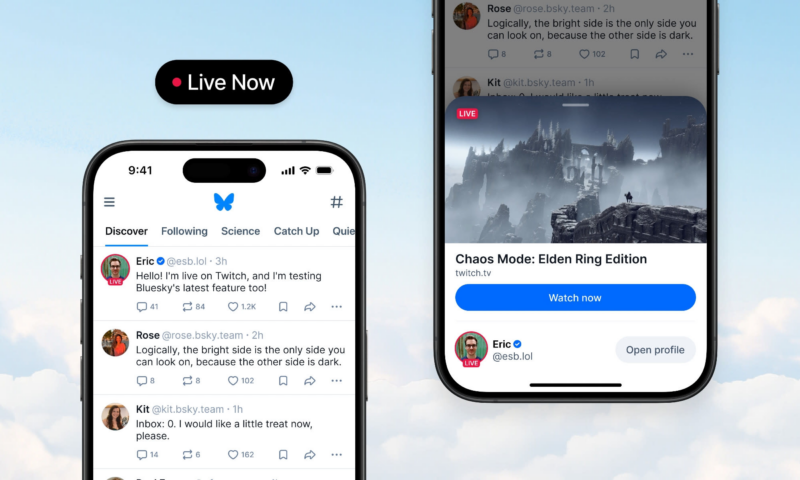
On Bluesky, Live does not present itself as a separate mode or a loud feature demanding attention. Instead, it functions as contextual awareness. When something is happening right now — a discussion gaining momentum, a creator going live elsewhere, or an event unfolding — Bluesky surfaces that information gently within the existing feed structure.
This is a crucial design choice.
Rather than forcing users into a live-viewing experience, Bluesky lets Live signals exist alongside regular posts. The feed remains readable, chronological, and human, while still conveying immediacy. Live becomes informative rather than intrusive.
By emphasizing signals over spectacle, Bluesky reframes what real-time interaction can be. You are not pulled into Live content by default; you are simply made aware of it and allowed to decide whether it matters to you.
How Bluesky’s Live features differ from others
The difference becomes clearer when contrasted with X, which has long been built around real-time dominance. On X, Live is closely tied to amplification. Trending topics, viral loops, and native livestreaming are designed to accelerate visibility as quickly as possible, often at the cost of coherence or depth.
X’s model prioritizes scale, velocity, and reach. Live moments are pushed into timelines whether users seek them out or not, and participation often feels compulsory rather than optional. This approach works well for breaking news and global events, but it also introduces noise, fatigue, and fragmentation.
Bluesky, by contrast, treats Live as emergent rather than imposed. Live moments grow out of communities and feeds users have already chosen. That bottom-up structure makes real-time engagement feel additive instead of disruptive.
Why engagement quality matters more than just activity based Live flags
One of the strongest indicators that Bluesky’s Live direction is aligned with long-term sustainability is the type of engagement it encourages. Real-time interaction on Bluesky tends to remain focused and conversational, even when activity increases.
On larger platforms, Live engagement often inflates numbers without deepening discussion. Replies multiply, but clarity diminishes. Bluesky’s Live signals, however, usually amplify conversations that already have shared context. Participants often recognize each other, understand the topic, and remain engaged beyond the immediate moment.
| Feature / Aspect | Bluesky | X (formerly Twitter) |
|---|---|---|
| Real-time discovery | Emerging / experimental; emphasis on making feeds feel live and relevant during events. | Mature real-time discovery with trending topics and rapid interaction loops. |
| Live video hosting | Not hosting natively — links out with indicators. | Has supported native livestreaming and big partnerships in the past. |
| User engagement style | Built for conversational flow and community-focused interaction; smaller but deeper engagement in some topics. | Fast, large-scale, and often broad engagement with public audiences. |
| Audience size | Smaller and growing; features aim to enhance engagement quality over reach. | Very large global user base with significant real-time buzz and trending behavior. |
| Monetization / Commercial goals | Leaning away from ads, making engagement itself a core experience first. | Monetization (ads + premium) integrated into real-time usage and live features. |
This shift from volume to quality is not accidental.
It reflects an understanding that meaningful real-time interaction is less about being seen by everyone and more about being understood by the right people.
Strategic restraint instead of feature overload
Bluesky’s choice not to host native livestreams is frequently misunderstood as a limitation. In practice, it represents strategic restraint. By allowing creators to go live on external platforms while surfacing those moments contextually, Bluesky avoids becoming an infrastructure-heavy broadcaster.
This approach reduces technical strain, simplifies moderation, and prevents Live content from overwhelming the feed. More importantly, it reinforces Bluesky’s role as a connector rather than a controller of real-time experiences.
The platform does not attempt to own Live content.
It simply helps users discover when something relevant is happening right now.
That restraint stands in contrast to platforms that equate progress with feature accumulation, often at the expense of usability.
Where Bluesky’s Live feature stands out
Bluesky is still defining its identity. At this stage, introducing Live features that respect user attention is far more valuable than chasing scale prematurely. Overly aggressive real-time systems could easily undermine the calm, readable environment that initially attracted users.
By integrating Live subtly, Bluesky strengthens its core promise rather than diluting it. The platform becomes more timely without becoming chaotic, more dynamic without becoming exhausting.